What does it mean to betray someone or something? Judas is often portrayed as betrayer, as almost a pantomime villain. But is this fair?
We only have what the gospel writers tell us about Judas, of course, and they paint him in a pretty unsympathetic light. There is a hint of scapegoating or ‘othering’ about the way we are encouraged to see Judas as unlike us.
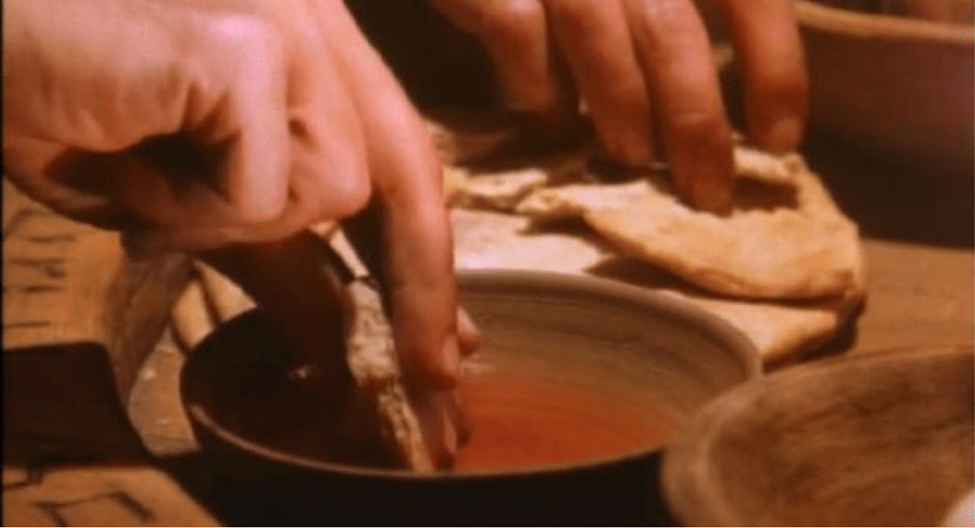
But are we so very different? And are the uncomprehending disciples, dipping bread in the sauce along with Judas and Jesus without understanding the significance of this last supper, are they any more faithful as friends?
Judas’ betrayal of Jesus may have been prompted by greed, as some gospels assert, or by a nobler ambition to have Jesus show his true power by pushing him to force his hand. We don’t know. John’s gospel says, ‘Satan entered him.’ Jesus had been tempted by Satan – the Enemy- but had not given in. Judas allowed him in.
Judas will betray Jesus with a kiss. The sign of friendship will become the act of an enemy.
All of this is part of a larger theological narrative where Jesus’ Passion is the means of reconciliation between God and humanity. Like the complexity of Judas’ relationship with Jesus, however, the atonement is not a simple substitution.
What matters to me is that Jesus never stopped loving Judas. Perhaps Judas’ true betrayal was that he pushed that love away and would not be embraced by it. He could not allow himself to be vulnerable. Perhaps he could not love himself.
George Herbert’s poem Love comes to mind:
LOVE bade me welcome; yet my soul drew back,
Guilty of dust and sin.
But quick-eyed Love, observing me grow slack
From my first entrance in,
Drew nearer to me, sweetly questioning
If I lack’d anything.
‘A guest,’ I answer’d, ‘worthy to be here:’
Love said, ‘You shall be he.’
‘I, the unkind, ungrateful? Ah, my dear,
I cannot look on Thee.’
Love took my hand and smiling did reply,
‘Who made the eyes but I?’
‘Truth, Lord; but I have marr’d them: let my shame
Go where it doth deserve.’
‘And know you not,’ says Love, ‘Who bore the blame?’
‘My dear, then I will serve.’
‘You must sit down,’ says Love, ‘and taste my meat.’
So I did sit and eat.
Self-giving God
Whose loving never ends
Open our eyes to see ourselves and our world as you do
So that we may share your friendship
And return love for love.
Amen.
 Stepping out of the boat...