Sitting with loss

It is a beautiful Autumn day here by the Sea of Galilee. The sun, though still warm, is not relentless as it is much of the time here, and the air is still and clear. This morning, I sat at a home with colleagues from the Scots Hotel with one of the staff whose mother died quite suddenly last week. We sat under a white canopy and sipped coffee and water and the conversation ebbed and flowed, encompassing various cat stories and weaving back round to the loss: ‘She was my mother, but she was also my best friend. I can’t imagine life without her.’ This is a human moment of loss and comfort and friends sitting together.

We drive back to the hotel past all the empty beach resorts, closed because of the heightened security advice, and I wonder about all those unemployed or facing financial ruin. The sun continues to glint on the calm waters of the Sea of Galilee. It is a very beautiful place. Overhead a sonic boom: a war plane on its way to or from Lebanon, only 60 km to the north. Today, the Israeli military ordered people in Tyre to evacuate. I heard a commentator say that something apparently humanitarian has been co-opted as a weapon of war. The displaced have nowhere to go, and as in Gaza the majority of casualties are non-combatants.

The news out of Gaza is available in Israel, but the vast majority of people have blinkered it out. There  are brave exceptions. Dahlia Scheindlin, along with her Haaretz colleague Gideon Levy, write against the tide. In her latest article (which you’ll need to register to read – but it’s free) https://www.haaretz.com/israel-news/2024-10-27/ty-article/.premium/gaza-is-the-horror-that-cant-be-denied-but-israelis-will-try/00000192-cf22-d4a2-ab97-cf2fe1640000 she writes: ‘Denialism kicks in when events are too terrible to admit.’

She discusses the use of the phrase ‘humanitarian zone’. ‘The IDF,’ she writes quoting Tanai Hary, a human rights advocate, ’says it has expanded the humanitarian zones for Gaza’ but ’there is nothing actually humanitarian about the humanitarian zone…there’s not enough aid or shelter for people there, and airstrikes still take place in the zone.’

Screening out inconvenient truth is not unique to Israelis. Palestinians do it too. Many deny the October 7th atrocities, according to Scheindlin. But she says, what matters right now is stopping the war. The destruction and humanitarian disaster in Northern Gaza is overwhelming. Very little food, fresh water or other supplies are getting in, and medical facilities are not able to function.

Yesterday, the Knesset passed two bills outlawing UNWRA from Israel. The United Nations Relief and Works Agency provides education, social welfare, food and other services not only in Gaza but also in the West Bank. They are the only agency who have consistently managed to get aid to starving Gazans, despite being compromised by Israeli accusations of staff members’ involvement in Hamas. Both the US and the UK have condemned the ban.

It’s not that UNWRA is an unqualified success. Some have argued that UNWRA has allowed the Occupation to more or less succeed for more than 50 years, by propping up the system, though Israel have long wanted rid of it. It is a time of absolute crisis not only in Gaza, but also in the West Bank where flying checkpoints, house invasions, settler violence against olive pickers and herdsmen make life intolerable.

Israeli hostages, living and dead, are still held in Gaza. Israeli soldiers are being killed on the ground in Lebanon and Gaza. Each one is rightly named and mourned. But hundreds of thousands of Palestinians and Lebanese (many of them with Palestinian ancestry) are existing on the edge, and many are being killed. There is no time to mourn. Who can be surprised if there are knife attacks by young boys or truck rammings? In both these instances, the perpetrators were shot dead at the scene. These are not so much acts of resistance but inchoate rage; and suicide by soldier (or armed civilian). But the loss all round is incalculable.

As I write, the sun streams warmly through the window. I can hear sounds of daily life continuing in the street. I find myself conflicted. I know so much about what is going on, so nearby, and I am cushioned from it. I am exhausted with helplessness. I don’t know what I can usefully contribute.

Words ring hollow, and there seems so little I can do. How to keep going?

In this I have been greatly helped by an extraordinary article in Sunday’s National (27th October 2024) by Alison Phipps. Alison is UNESCO Chair for Refugee Integration through Education, Languages and Arts at the University of Glasgow. She has worked with colleagues from Gaza for the past fifteen years, and much of the appalling news is personal. Over the years, and since October 7th she has used her gifts of language and poetry to process the inhumanity. On Sunday she wrote, ‘For more than a year now, I have been, like so many readers, lost for words in the midst of terror, in the midst of horror….but it’s literally my job to find the words.’ Her article is called ‘Seven words to save our sanity in the midst of the terror in Gaza’. Her seven words are genocide, prevention, helpful,  lean, tell, abomination, and love.

Some of these are big words that demand response from a muted world, but three of her words seem to particularly speak for me in this moment. They are lean, tell, love.

When images and words are sickening, of men stripped naked with hands tied behind their backs, or another parent with a small bundle of dead child, it is easier to turn away. And so to lean in and pay attention, as friends do (Christian, Muslim and Jewish) sitting shiva with a bereaved colleague, is important. And to remember all the dead, the named and the unnamed.

It is important, too, to try to tell the story and inform the prayers, and to encourage you to lean in too, and not turn away.

And, finally, and in the beginning, love is key.

Alison finishes her article, ‘We must never tolerate the intolerable. We must never surrender our love.’

My Scripture reading this morning is that extraordinary set of sayings of Jesus which ends, ‘ You have heard it said, ‘Love your friends, hate your enemies’. But I say to you, love your friends and pray for those who persecute you, so that you may become the children of your Father in Heaven.’ Matt 5:43-46

I have no idea what it is like for a Palestinian Christian to read this text. I do not presume. But I remember Nader Abu Amsha of DSPR (Department of Support for Palestinian Refugees) talking about a card visible over his shoulder during a recent Zoom call. It read ‘Hope is stronger than fear.’ He talked about the God of Love who is able to do more than we can ask for or think about. And that it is imperative to hope that things can change for the better, even as we sit with loss.

Remember their names

Graham and Anne Bryce https://www.justgiving.com/page/brycesonbikes are cycling from Glasgow in Scotland, hoping to reach Bethlehem in the occupied Palestinian territory. They will pause in Greece and assess the current situation before deciding how to continue. As they cycle, each day they post a short reflection on Tiktok and Instagram where they read out the names of children killed in Gaza.

Recently the names of the dead (as far as known) were published by the Health Ministry in Gaza. The names of children aged less than 1 year old spanned 14 densely typed pages. Death is so routine, medical care so decimated, the stuff of survival like clean water and shelter so limited, that without huge medical and humanitarian aid the death toll will rise inexorably.

https://www.facebook.com/reel/1903908653464068

The Bryces’ cycle comes a year after October 7th 2023, but their mighty effort is borne out of years of commitment to the people of Palestine and MAP (Medical Aid for Palestine).  Their compassion and commitment comes from relationships with Palestinians met during previous visits to the West bank in support of MAP.

There’s been a bit of a theme running recently in this blog about the importance of individuals and the value of each human life. This against a backdrop of increasing dehumanization and objectification.

As those who have studied genocide have charted, name calling, objectifying, dismissing another human being or group of human beings makes it far easier to attack and even obliterate them.[1]

The polarization within Israeli society is almost total. There was a story in Haaretz on 24th September[2] about a young Arab Israeli girl who expressed sympathy for Palestinian children in Gaza, and was then turned on by her classmates. They surrounded her chanting, ‘May your village burn!’ Videos were shared and many comments were made, inciting violence against the girl.  Accusations were made about her being a Hamas supporter and she was excluded from school, at first as ‘disruptive’ but then ‘for her own safety’.

There have now been calls for her expulsion and some have even said her parents’ Israeli citizenship should be revoked. The girls’ version of events is that she commented in a class discussion that small children in Gaza are suffering and dying from hunger.

The bravery needed to point out the ongoing horror in Gaza and the death of innocents and the refusal by adults and children alike to entertain that thought is a microcosm of life here. A Haaretz editorial the next day criticized the adults involved, including the school principal and the deputy mayor of Be’er Sheva.

The girls’ own account of what she says differs from her classmates. Her father offered to come to school and speak to the class and was refused. A new hijab wearing student in a predominantly Jewish classroom would find life difficult anyway. Now it is impossible.

You can draw your own conclusions about the situation of Arab Palestinians in state schools, in society; and about the near-silence on the suffering in Gaza. There are still weekly demonstrations about ceasefire and hostage return, but little sense that the underlying injustice of occupation and dehumanization of Palestinians has much traction in society.

I find it difficult to see where this can go. As the anniversary of 7th October comes up, the shock and pain have hardly shifted, and the suffering of those held hostage and their families is unimaginable. But without a wider perspective that also sees Palestinians as human beings with rights which have been overlooked for too long, and who are suffering terribly, either we are looking at wiping 2 million people off the map or some sort of accommodation which makes life bearable for everyone.

Since I started writing this blog, the Israeli military has pushed forward on the northern border with rising death toll and a million people displaced, and Iran has responded with a rocket attack. Israel has promised to retaliate to that. It is difficult to see how a way through will be found where peace with justice will be available for all. The commitment of the Bryces to remember the children, and the empathy of an Arab Israeli school girl encourages and inspires me.

May we remember all the names.


[1] https://www.ucu.org.uk/media/9609/10-Stages-to-Genocide/pdf/10_Stages_to_Genocide.pdf

[2] https://www.haaretz.com/israel-news/2024-09-24/ty-article/.premium/israeli-arab-girl-12-suspended-from-school-after-empathizing-with-gazan-children/00000192-206a-dc44-affb-39fb8a800000

Tell My Story

On October 11th last year I was meant to travel to Gaza along with my colleagues Stewart Gillan, minister of St Andrew’s Jerusalem and Doug Dicks, our Ecumenical Associate, who has worked here in Israel/Palestine for many years with the Presbyterian Church of the USA. The Department of Services to Palestinian Refugees (DSPR), part of the Middle East Council of Churches (MECC), was to have been our host. We would have visited clinics and workshops, psycho-social projects which help children live with trauma, and IT training projects.

Of course, these hopes came to nothing. The horror of October 7th put paid to our plans, and the horror since means that the places and the people we would have visited have changed beyond recognition, and some of the people we would have met have been killed.

The numbers are beyond comprehension. Between 7th October 2023 and 8th September 2024, according to the Ministry of Health in Gaza, at least 40,972 people have been killed and 94,761 have been injured. These numbers are likely not high enough, because bodies are missing under collapsed buildings or have been vaporized by the ordinance used, such as 2000lb bombs.

According to Wikipedia, quoting Euromed Monitor, by late April 2024 it was estimated that Israel had dropped over 70,000 tons of bombs over Gaza, surpassing the bombing of Dresden, Hamburg and London during World War II.[1]


All these enormous numbers make it hard to sustain empathy, or even begin to imagine the devastation and the multiple traumas experienced.

A letter sent 8th September from our partners the DSPR- MECC, whose projects we would have been visiting, has made it real. I’m going to quote their tribute to their colleague Wala’ Fathi Al-Masri, a nurse, killed that day.

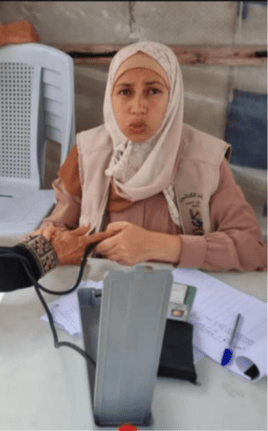
Wali’ Fathi Al-Masri 1984-2024

 ‘Just moments ago, we were struck by the heartbreaking news of the loss of our dear colleague, Wala’ Fathi Al-Masri and her daughter Mira. They were tragically killed in a brutal shelling attack on a residential area of Khan Younes, and her three sons were injured. Wala’ was a dedicated nurse who had been with DSPR-MECC Gaza for over 15 years, who showed a strong commitment and compassion. Born in 1984, she served with distinction in our clinics in Al-Shejaiya and Al-Daraj before the war on Gaza. She and her family were forcibly displaced to Rafah during the first month of the war, where she served as a nurse in our Rafah clinic for several months, then was forced to move again with her family as a result of the invasion to Rafah on 6th of May. Wala’ continued her work as a nurse in the mobile clinics in Khan Yunes and Dair El-Balah until she was killed in this barbaric attack.

Wala’ was a role model of resilience and kindness, always maintaining her smile and sense of humor despite the dire circumstances. Her dedication as a mother to her three sons and daughter, as well as her professionalism as a nurse, was extraordinary. As we mourn her loss, we pray for her and her daughter’s souls to rest in peace and hope that her three sons receive the medical treatment they desperately need amidst the collapse of the healthcare system.’[1]

Wala’ and her family had been forced to move at least twice and DSPR clinics were destroyed. Despite this, Wala’ and her colleagues set up mobile clinics, using their skill and treating people in whatever way they could.

The Israeli  Army claim that Hamas operatives are based among the civilian population. Hamas has denied this, though there is some evidence of using civilians as cover. Given the total destruction of much of Gaza, which is a small piece of land anyway, (365 sq kilometers) the proximity of civilians to Hamas fighters is inevitable. Ninety percent of Gaza’s population – more than 2 million people – is currently displaced, and almost all of them are crowded into a ‘humanitarian zone’ designated by the Israeli military, which covers 14 percent of the centre and south of the Strip in the areas of Mawasi, Khan Yunis and Deir al-Balah.[2]

As the anniversary of 7th October approaches, less than one month away, I wonder how this anniversary can be marked in a way that recognizes the human suffering and loss of Israelis and Palestinians but does not draw crass equivalences or minimize responsibility for using weapons of such magnitude against a largely female and youthful population. I asked an Israeli friend. ‘Lament’, she said.

And perhaps in our remembering we need to focus in on individuals who should all have equal rights and status as human beings, and whose sense of care and duty and resilience and humour needs marveled at and celebrated; as well as deeply mourned.

The World Council of Churches has designated 16-22nd September as The World Week for Peace in Palestine and Israel. The theme is ‘Gaza’ and the Scriptural text is Matt 25:40 ‘Lord, when did we see you?’[3] Stewart Gillan and I have written a liturgy on these themes, modelled on our order of service here in St Andrew’s Jerusalem and Tiberias. It is available here:   https://www.churchofscotland.org.uk/worship/weekly-worship/monthly/2024-september/additional-material-for-the-week-of-prayer-for-peace-in-palestine-and-israel-16-22-september-2024

Included in it is a poem by Rafaat Alaarer who was killed in Gaza on 6th December 2023.

If I Must Die by Rafaat Alaarer

If I must die,
you must live
to tell my story
to sell my things
to buy a piece of cloth
and some strings,
(make it white with a long tail)
so that a child, somewhere in Gaza
while looking heaven in the eye
awaiting his dad who left in a blaze —
and bid no one farewell
not even to his flesh
not even to himself —
sees the kite, my kite you made, flying up above,
and thinks for a moment an angel is there
bringing back love.
If I must die
let it bring hope,
let it be a story.

Rafaat Alaarer, poet and professor and citizen of Gaza, pinned this poem in a Tweet. He was killed on 6th December 2023. He has no surviving family and no lawyer to process literary editorship. It is the world’s most recited poem and there is a Twitter thread of it translated in every language.


[1] https://euromedmonitor.org/en/article/6282/200-days-of-military-attack-on-Gaza:-A-horrific-death-toll-amid-intl.-failure-to-stop-Israel%E2%80%99s-genocide-of-Palestinians

(2) https://www.mecc.org/

[3] https://efe.com/en/latest-news/2024-09-10/gaza-war/

[4] https://www.oikoumene.org/resources/documents/seven-days-seven-themes-for-the-world-week-for-peace-in-palestine-and-israel-2024

The Power of One…

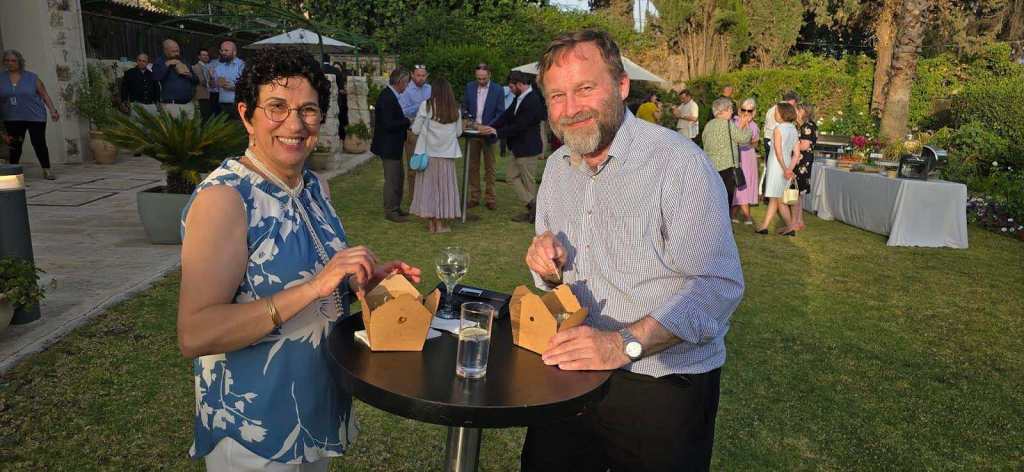
Today at St George’s Cathedral in Jerusalem the funeral will take place of Salwa Duaibis a Palestinian Christian who has worked tirelessly with the organization Military Court Watch (MCW). I met her briefly at a recent garden party at the British Consulate in Jerusalem. She was lovely. Very kind, very compassionate, and very tired.

Rev Dr Stewart Gillan and Salwa Duaibis

Since October 7th the Military Courts have been processing minors at a greater rate than ever. MCW wants to confirm that where young people are detained they are treated properly, arrested properly and held in internationally accepted conditions. They are not. Testimonies of former detainees tell over and again of brutalization, inhumane treatment, poor conditions. Salwa was part of a small team collecting these stories, supporting young people by attending court when family access was denied, and highlighting the issues. Just last week I sent her a message to try to arrange for Stewart and me to visit a court with her.

Salwa had a stroke and then a further series of fatal strokes. I’ve been reflecting how profoundly so many people will be affected by her death: the Sabeel community, where Cedar, Salwa’s mother, is such a force; Palestinian Christians who are all so interconnected; MCW and all the families they support.

Who will take her place, I wonder? She shouldered a huge responsibility and had a vital role in learning and telling truth. One person; one story; one huge loss.

Earlier this week I was contacted by a trusted friend. Through an intermediary who can get money into Gaza he has been supporting a family since October 7th. I suspect this quiet charitable giving is going on a lot. I’ve noticed on X recently many more pleas for help: Individuals asking for money by Paypal or any means possible. I am sceptical. Although the need is almost overwhelming, how can we be sure this isn’t a variation on that well known Glasgow scam: ‘I need the train fare to get to my mother’s funeral in Aberdeen’? This makes me unwilling to respond to strangers encountered in this way.

My friend is utterly reliable, however. The young man he was supporting is now on his own: his mother and his brother are both dead. He needs money for a tent. It’ll cost 3000 NIS or £615 (approximately). The inflation in price is a cost of war, profiteers are doing very well, thank you. But this is the going rate, we believe. And we’ve been asked to help.

My friend says, ‘I can’t do it myself any more. I have medical expenses and other bills. Can you help?’

This young man is one out of possibly 1.9 million displaced people in Gaza. The UN estimates 9 out of 10 people have had to move from their home and have been moved repeatedly since. The Israeli army has been issuing evacuation orders: five in the last week alone, and sixteen in the month of August. These orders are an attempt to be seen to be ‘protecting civilians’ but the truth is there is nowhere to go and civilians have nowhere to hide from the relentless bombardment which goes on even as peace talks are brokered. UNOCHA reports that between 7 October 2023 and 26 August 2024, at least 40,435 Palestinians were killed and 93,534 were injured, according to MoH in Gaza. The numbers are so vast, it is hard to imagine.

You will have seen images of tired and dusty people with armfuls of clothing and small children dragging jerry cans, on the move. There are thousands of them, with nowhere to go.

Displaced Palestinians make their way as they flee an area ordered to evacuate by the Israeli army in Deir Al-Balah in the central Gaza Strip August 25. REUTERS/Ramadan Abed

In her acceptance speech at the Democratic Nominating Convention Vice-President Kamala Harris talked briefly about the suffering of Gazans, but she spoke in passive terms, with no mention of the causes of the suffering or the people behind it. Accepting that Hamas hold some responsibility, it is the Israeli military, backed by the USA, and others, who have almost totally destroyed the infrastructure and history of Gaza. It is the Israeli military who are firing on tents and people crowded into schools for refuge.

One young man needs a tent. Can we help?

Making a Statement

On 13th August 2024, the Israel Palestine Committee, carrying out the instructions of the 2024 General Assembly of the Church of Scotland, wrote to Rt Hon David Lammy, the new foreign secretary. https://www.churchofscotland.org.uk/news-and-events/news/articles/church-writes-to-foreign-secretary-on-israel-gaza-war

There is always pressure for churches to be reacting and responding to world events and events at home. I remember when I was part of the Church of Scotland’s Church and Society Council (R.I.P) that convenors were constantly being asked to make statements and press releases. The broad range of views on most topics, the need to have General Assembly backing for important pronouncements, and the need to move beyond talk to action and not to speak in isolation from ecumenical and interfaith partners make this process fraught. There is a real possibility of producing a lot of words which affect nothing positively.

A recent example of a statement made in support of Palestinian Christians which caused an unforeseen negative reaction among some is the World Council of Churches’ ‘Statement of the escalating crisis in Gaza.’ The World Council of Churches, ‘a worldwide Christian inter-church organization founded in 1948 to work for the cause of ecumenism’ is a fellowship of 352 denominations from more than 120 countries, representing over 580 million Christians worldwide.[1] The executive committee of the WCC meeting in Bogota, Colombia 6-11th June 2024 produced the statement.[2] I can imagine the drafting and redrafting that went into writing that document, having been part of such drafting committees myself. On June 19th 2024, Kairos Palestine, ‘a Christian Palestinian movement’ born out of writing the Kairos Palestine document, wrote an open letter in response.[3] https://united-church.ca/news/kairos-palestine-responds-world-council-churches-statement

Ostensibly, the WCC statement was made in support of Palestinian Christians. The response of Kairos Palestine illustrates exactly why such statements can have the opposite effect to that intended.

First, Kairos Palestine’s letter firmly rejects the WCC description of Israel’s ‘ongoing military aggression in Gaza’ as an ‘escalating crisis’. The WCC statement is wary of using the word ‘genocide’, and does not reference the ICJ provisional finding that Israel is ‘plausibly committing genocide in Gaza’[4] or the UN Commission of Enquiry which concludes that ‘Israel is committing the crime of Extermination against the Palestinian people.’[5]

Litotes, the opposite of hyperbole, is often used for fear of causing offence. Its use here has caused great offence to Palestinian Christians and their supporters.

Secondly, the Kairos letter writers, normally polite and neutral in their responses, ‘deplore’ the failure of the WCC statement to set the ongoing atrocities in the context of the ‘seven decades colonial regime’ and occupation and increasing escalation of violence, house demolition, settler expansion, displacement and arrests in the West Bank, including East Jerusalem.

As a consumer of media here in Israel I see the outrage felt by Israelis about October 7th, who feel violated and very afraid, recycled in every bulletin. It is very rare for the context of occupation and the sense that the world was not paying attention, which emboldened the Hamas attack, to be mentioned. The same omission in the WCC statement is thus felt even more deeply.

‘As the statement lays out the drastic statistics of the genocide in Gaza, it does not directly point to Israel, the perpetrator.’[6]

The WCC statement is also criticized for using strong language of condemnation for Hamas’ actions without using the same strong condemnation of Israeli actions. There is talk of the need for increased humanitarian aid without condemning the deliberate withholding of aid.[7] ‘No amount of aid can replace the Palestinian quest for freedom and justice. This should be the essence of the statement and any act of solidarity.’[8]

Statements, in an attempt to be fair, often ‘both side’ the criticism of violence and the call for accountability, ‘despite,’ as the Kairos letter says, ‘the stark differences in power dynamics.’ The result is ‘to obscure the massive asymmetry of powers and the seven decades of colonization of Palestinian land and oppression of its people.’ Both side-ism equates the nearly 40,000 Palestinians killed in Gaza and the 1200 Israelis killed on October 7th. Kairos Palestine ‘upholds the God-given sanctity of life for all people’[9] but the media, generally, does not. Palestinians are ‘terrorists’ and Israeli soldiers are ‘patriots defending their country’. Rarely are Palestinians described as acting in self-defense.

The WCC statement rightly condemns sexual atrocity against Israelis, but does not condemn longstanding practices used by the Israeli military to sexually humiliate: ‘forced public nudity, forced public stripping, sexualized torture and abuse and sexual humiliation and harassment.’[10]

In its demand for the immediate and unconditional release of all hostages in Gaza and all persons detained in Gaza and the West Bank without due legal process the WCC statement again fails to recognize the asymmetry. There are an estimated 140 hostages in Gaza and nearly 9000 Palestinian prisoners, almost 3,500 held without charge.[11]

I find myself extremely uncomfortable with the numbers game, since every human life is precious, but unless the numbers are used, the inequality and scale of the injustice is obscured.

The WCC statement ‘urges all members of the international community to rediscover their moral and legal commitment to the equal rights of all, to uphold and apply the principles of international law without discrimination and intensify efforts to promote and implement a just peace.’[12]

There is no explicit condemnation of the hypocrisy of western powers calling for peace and de-escalation while sending weapons of war and finance to Israel. There is no explicit mention of the striking interim findings of the International Court of Justice following the preliminary case brought by South Africa or the application of the International Criminal Court Prosecutor which calls for arrest warrants to be issued to leaders of both Israel and Hamas.

The Kairos Open Letter asks the World Council of Churches to ‘go beyond a call for immediate ceasefire to call for decolonization of the Palestinian lands and an end to oppression.’[13] I understand why the WCC has not done this. The existence of the State of Israel since 1948 is not on the table. The two state solution, increasingly imperiled by Israel’s illegal settlement construction, changing facts on the ground, is still the WCC position (as it is the Church of Scotland’s).

As I see it, the standard has to be recognition of the human rights of all people, both Palestinian and Israeli as ‘a cornerstone for peace’.[14] But this is only credible if the WCC offends many nations, including the UK and the USA, by calling out their hypocrisy.

This is the path trod by the prophets, and that is the final summary of the Kairos letter:

‘At the time of genocide, we need the churches and their widest ecumenical expression, the WCC, to voice their prophetic voice, to avoid neutrality and not to be “balanced” in the midst of genocide, and not to ignore a brutal colonization that preceded October 7th by seven decades.’[15]

The penultimate paragraph of the Kairos letter says, ‘We do not need a statement that comes 8 months too late, but rather an action plan for the implementation of the unique Christian message and mission which churches should contribute to the struggle against genocide and ethnic cleansing practiced by Israel against the Palestinians.’[16]


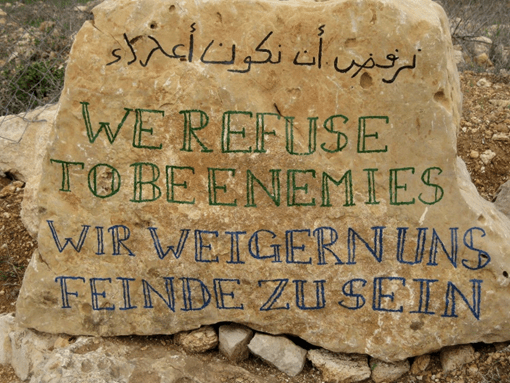
And there’s the rub: for what actions can Christians take? And what is unique about the Christian message? I return, as I often do, to the weathered stone which sits at the gateway to the Tent of Nations: We refuse to be enemies. Jesus’ call to love enemies and do good to those who persecute you is more than challenging.

The Kairos letter finishes with a quote from the original Kairos document (section 3.4.1):

The mission of the Church is prophetic, to speak the Word of God courageously, honestly and lovingly in the local context and in the midst of daily events. If she does take sides, it is with the oppressed, to stand alongside them, just as Christ our Lord stood by the side of each poor person and each sinner, calling them to repentance, life, and the restoration of the dignity bestowed on them by God and that no one has the right to strip away.

Although statements from churches about world events and injustices are often called for, and when written are agonized over to get the wording ‘right’, it is easy for others to see what is ‘wrong’, as Kairos Palestine’s reaction to the Bogota statement of June 2024 shows.

What is needed is deeper theological reflection that leads to action, so that statements are not so much position papers but statements of intent and calls to action.

It makes sense then to have fewer statements but make them bolder, more prophetic and more practical.

As always, the views expressed in this blog are personal and not the views of the Church of Scotland.

[1] https://www.oikoumene.org/about-the-wcc

[2] https://www.oikoumene.org/resources/documents/statement-by-the-world-council-of-churches-on-the-recent-escalation-of-violence-in-the-middle-east

[3] https://united-church.ca/news/kairos-palestine-responds-world-council-churches-statement

[4] https://www.icj-cij.org/sites/default/files/case-related/192/192-20240126-ord-01-00-en.pdf

[5] https://www.ohchr.org/en/news/2024/06/commission-inquiry-occupied-palestinian-territory-concludes-israeli-authorities-and

[6] Open Letter paragraph 3.

[7] There is evidence that Hamas have also prevented distribution of food aid.

[8] Open Letter paragraph 4.

[9] Open Letter Paragraph 5.

[10] https://www.ohchr.org/en/news/2024/06/commission-inquiry-occupied-palestinian-territory-concludes-israeli-authorities-and

[11] https://www.btselem.org/statistics/detainees_and_prisoners

[12] WCC Statement page 3.

[13] Open Letter paragraph 9.

[14] Open Letter paragraph 9.

[15] Open Letter paragraph 9b.

[16] Open Letter paragraph 9c.

Umm al-Khair II

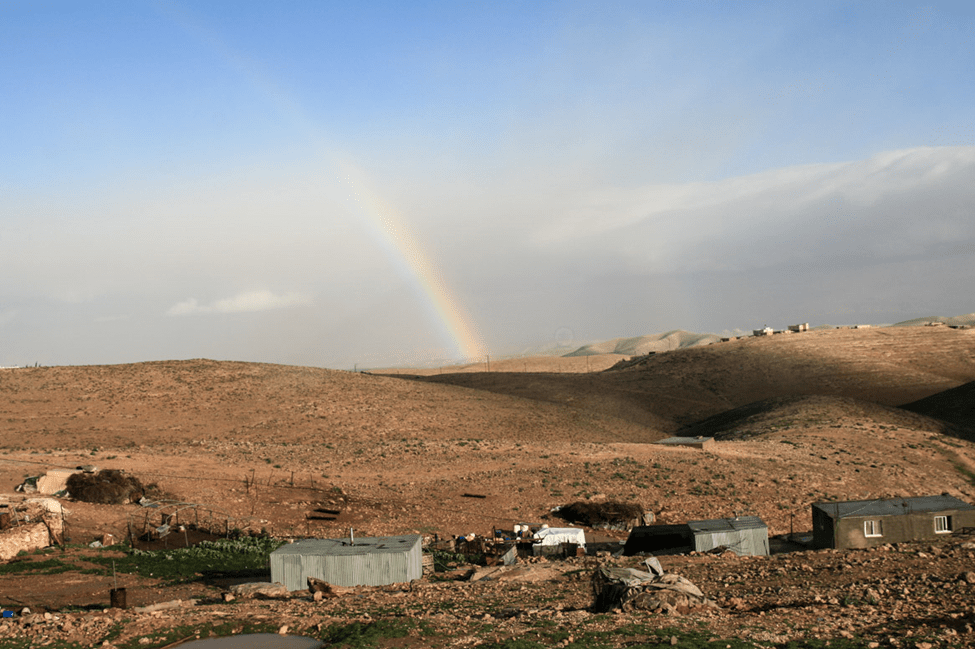
Following my last post, I thought I should update you. Despite international attention and efforts by local supporters, the persecution of the villagers of Umm Al-Khair continues. The demolition I told you about destroyed eight buildings and left over thirty people, including women and children and babies, without a roof. Observers such as those of the Villages Group https://www.facebook.com/villagesgroup document the house demolitions, arrests, building of new illegal settlements and the continued oppression. Local authorities fail in their duty to protect. Settlers act with impunity. And remarkably the villagers of Umm al-Khair continue to resist peacefully, using social media, photography, art and physically putting their bodies in harm’s way to protect what is a very simple and very poor way of life.

Photograph from Living Archive https://living-archive.org/village/um-el-khair/?lang=en

This week two weddings were planned. Well in advance, permission was applied for to put up a wedding tent for the women.

One of the locals messaged:

Earlier this evening the army came to Umm al-Khair to take down a tent that was set up ahead of a wedding this weekend. The community had had approval from the civil administration ahead of time so following a phone call, the army left. However, that evening settler soldiers came back and began demolishing the tent by hand.

One of the members of the Villages group wrote to the Regional Commander:

I turn to you again about the wedding at Umm al-Khair since this is a crucial matter. The desperate villagers have given up their festive tent (which had been approved explicitly before the Carmel settlers intervened.) They have not brought a band or music, and plana modest wedding after having lost a considerable part of the village homes in a recent demolition.

All they are asking is to be allowed to hold the wedding quietly without military intervention, military presence, without settler attacks….They feel responsible for the hundreds of guests invited and do not wish this to become a complicated affair.

In reporting this, Erella concludes:

One does not need bloodshed to get depressed. I -not the direct victim, am only present with the direct victim – still need great vital powers in order not to lose faith in the human spirit, not to sink into deep depression. And they (the villagers of Um al-Kheir) where do they enlist such inner powers? How do they manage to stay balanced to the point that they do not get caught in the fangs of revenge and hatred? I do not know how, but they do. Great teachers.

Thanks to everyone who made a donation in response to my last post about Umm al-Kair. At the moment, the best way to get funds to the village for essential supplies is through HIRN (Hebron International Resource Network). Amos Trust are able to get funds to them. https://www.amostrust.org/palestine-justice/partners/hirn/

As far as we know, the two planned weddings have gone ahead. We pray for peace and prosperity for these newly married couples.

‘Please act now’

I’ve never been to Umm Al-Kheir, but I’ve heard a lot about it. One of my predecessors as Church of Scotland mission partner, Rev John McCulloch, went regularly to sit with the Bedouin of the village, to take small gifts for the children, and small sums of money. My colleague Rev Dr Stewart Gillan has visited at least once and I know the people hold a place in the heart of many former Ecumenical Accompaniers.

Um-Al-Kheir sits on land occupied by the Israelis in 1967. The settlement of Carmel occupies land their sheep once grazed. Um Al-Kheir has been the focus of activists highlighting the occupation and the oppression of the Palestinians for many years. One activist once observed the chickens in Carmel have more access to water and electricity than the villagers of Umm Al-Kheir.[1]


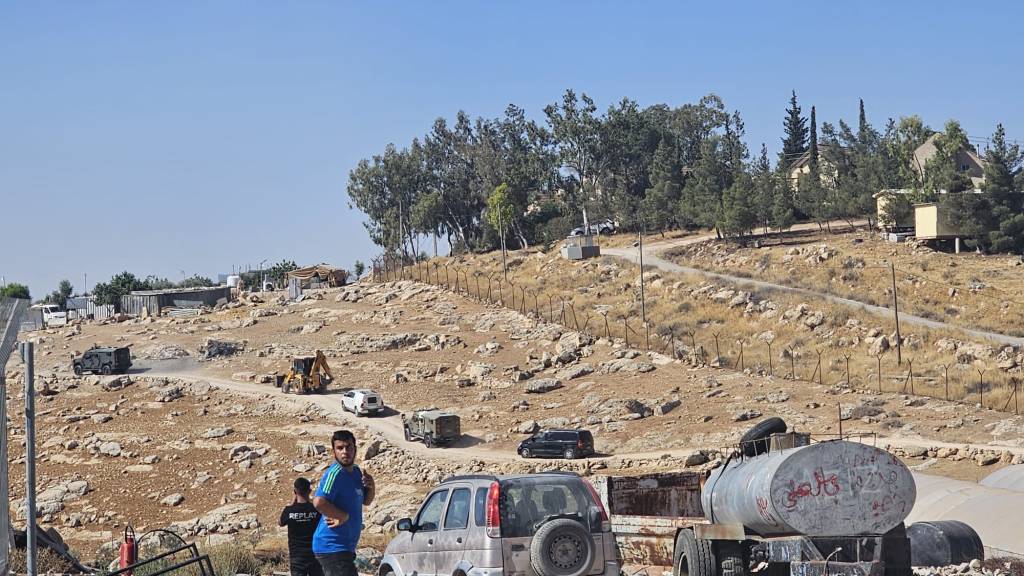
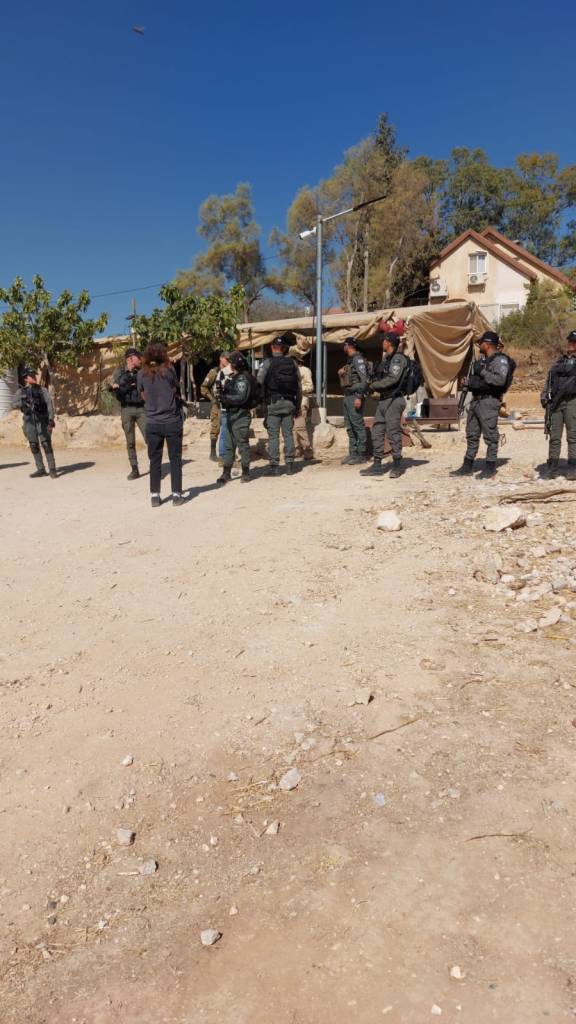
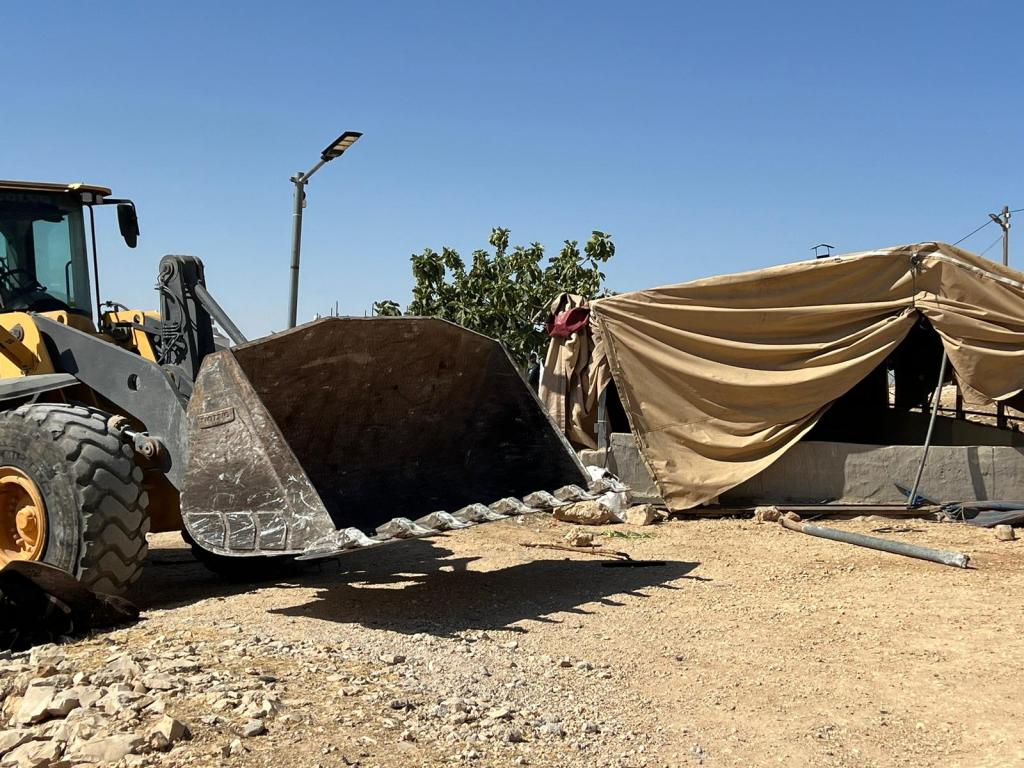
Today the bulldozers rolled in, accompanied by IDF soldiers. Messages started to arrive by What’sApp first thing. A procession of police vehicles, army vehicles and bulldozers were filmed snaking up the dusty track. Their first destination was the community tent which has stood since 2008. There has been a demolition order against it since then.


Photographs arrive showing a lone woman, arms folded, faced by a line of soldiers and Police, all armed of course. Right behind is the fence of the settlement of Carmel. Next to the fence, almost within touching distance, is a modern house with air conditioning units, pitched roof and shuttered windows. The tent in front is dilapidated, insubstantial. I commented on the contrast in our What’s App stream and my colleague (who had been an EAPPI some 10 years ago) responded that more shocking is the contrast between the lush vegetation of the settlement and the arid desert which was home to some 600 people in 2017.

There has been repeated demolition and rebuilding of houses in Um Al-Khair. The residents have receipts for land tax paid in one hand and demolition orders in the other.[1]

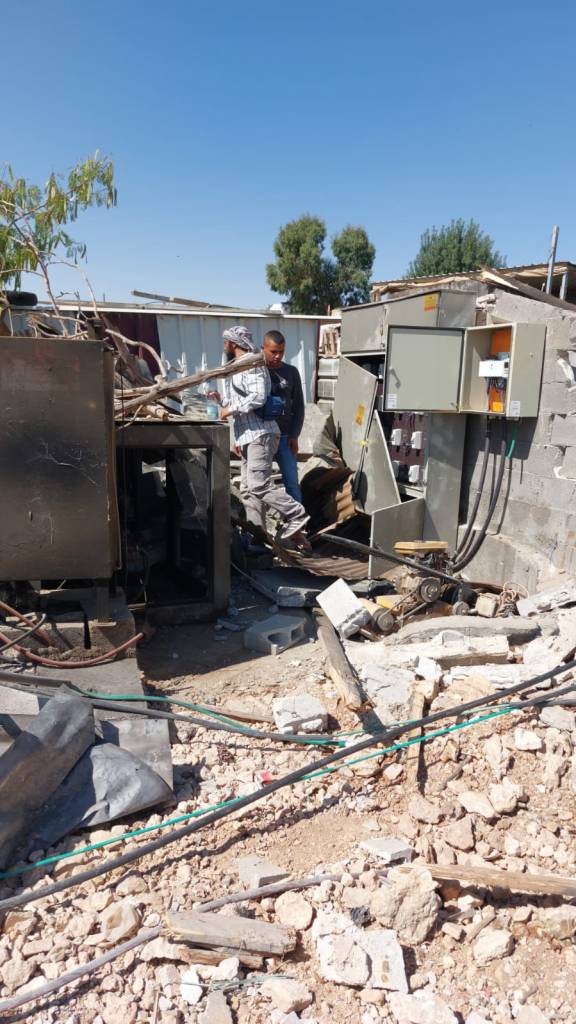
Within a few short minutes, messages are received showing photographs of the destruction. A voice message reports that so far three houses have been destroyed and twenty-five are scheduled to be destroyed. ‘This means that one third of the village will be homeless today. The weather is really hot and the house have been destroyed and the people cannot do anything. We need your help now. If you can do anything, please just act.’

What can we do? Stewart is off to talk to some media contacts. I am writing this blog. We can get some funds to the village via intermediaries but we are not able to visit ourselves.

Anton from Rabbis for Human Rights https://www.rhr.org.il/eng   reports he will visit on Monday. RHR have been delivering food aid to villagers since October 7th. The road blocks, blockades and aggression experienced by Palestinians in the West Bank, the lack of work, the impossibility of grazing flocks leaves an already vulnerable community in a parlous situation. Since 7 October 2023 and until 10 June 2024, across the West Bank the Israeli authorities demolished, confiscated, or forced Palestinian owners to demolish 990 Palestinian-owned structures, of which 34 per cent (366 structures) were inhabited homes displacing, 2,155 people, including 1,036 children.[1]

One of the houses destroyed today, according to the Villages Group   https://www.facebook.com/villagesgroup/ belongs to Eid Suleiman Adalin and his wife and five daughters. In 2011 Rabbis for Human Rights recorded Eid’s testimony, which The Villages group reposted today. https://www.facebook.com/RABBI4HR/videos/2015954087730/ His dignity and compassion shine through. He can empathise with Israelis under fire from Hamas rockets (this was in 2011) and asks why they can’t understand the pain he feels when his house is destroyed.


In her regular newsletters https://villagesgroup.wordpress.com/  Erela tells of sitting with village elders and young mothers. She reports on their stoicism and dignity and their non-violent resistance, which is ‘sumud’ writ large. Yet, though the villagers of Umm al-Kheir, many already displaced several times in their lives, have been resilient it seems that while attention is on Gaza and while there are few foreign national observers, and it is increasingly difficult for Israelis like Erela to get access, the bulldozing will continue with impunity. Where is there left for the villagers to go? Who is listening to them?

‘We need your help now. If you can do anything, please just act.’

If you can raise your voice, do. Ask questions of prospective MPs about recognition of Palestine and illegal occupation. Rabbis for Human Rights and The Villages Group both give small amounts of aid. If you donate online to the congregation (Jerusalem in the drop down menu) and mark your donation Umm Al-Kheir we can make sure it all gets to the people there. https://cos.churchofscotland.org.uk/donate/

[1] https://www.ochaopt.org/content/humanitarian-situation-update-178-west-bank

[1] https://en.wikipedia.org/wiki/Umm_al-Khair,_Hebron

[1] https://en.wikipedia.org/wiki/Umm_al-Khair,_Hebron

Only Compassion…

This is Avi Dabush, executive director of Rabbis for Human Rights. On October 7th he and his family hid in their safe room in Kibbutz Nirrim for eight hours when Hamas attacked. He thought, ‘maybe this is the end’. A Guardian article says ‘he speaks with authority when he says the October 7th attacks have caused a very deep wound and open wound on Israeli society.’

But Dabush is frightened that an even bigger threat to the safety of Israel is the almost overwhelming support for continued bombardment of Gaza. He says, ‘even though we are so many days after the beginning, people still believe that only with force can we make a new and better reality.’ He says, ‘I don’t believe that.’ He strongly supports a ceasefire and doubts Israeli military force will bring lasting peace.

He says, ‘We know from 2014 (Protective Edge) that more and more people in Gaza really hate Israel because of their experience: their houses are ruined, they are starving, their family members are dead.’

He calls what is happening ‘a very deep and radicalizing dehumanization on both sides.’

Hamas has no concern for ordinary Palestinians and 7th October shows a very deep dehumanization of Israelis; and, from the other side, Israelis who portray a Palestinian child as a potential Hamas sympathiser or future militant, and who believe the horrific death toll and suffering in Gaza is necessary, dehumanize Palestinians.

Dabush and RHR say Israel’s security has to be accompanied by human rights for Palestinians. They are calling for a ceasefire as being consistent with values of peace, human rights, justice and equality.

He says RHR believe it (the struggle) is not about Jews against Arabs, or Israelis against Palestinians, or vice versa. Its about people who believe in peace, human rights, justice and equality against people who do not.[1]

On Monday 3rd June, RHR with partners, including the Church of Scotland, organized an interfaith walk for peace from Zion Square to Jaffa Gate bringing together people of all faiths who share RHR’s commitment to human rights.  My colleague Stewart Gillan and I joined the walk.

It was not a large affair. It was a colourful and very mixed group: unusual on Jerusalem streets. People met and re-connected and new contacts were made. There was no right wing heckling, as there had been last year. All the speakers emphasized their commitment to peace with justice as the only path out of conflict.

I was particularly struck by some words from Thich Nhat Hanh quoted by Dr David Goren, the Buddhist representative.

Recommendation

Promise me,

Promise me this day,

Promise me now,

While the sun is overhead

Exactly at the zenith

Promise me:

Even as they

Strike you down

With a mountain of hatred and violence;

Remember brother*,

Remember:

Man is not our enemy.

Our enemies are:

Hatred, anger, fear,

Greed, fanaticism, discrimination, and delusion.

Man is not our enemy.

So please meditate on compassion, for all those who do not know that

this is the most incredible power a man can have.

Hatred will never let you face the evil on man.

Only compassion with courage intact can face

and even uproot

The evil in man.

*original non-inclusive language


[1] https://www.theguardian.com/world/2024/apr/02/meet-the-israeli-rabbi-and-survivor-of-7-october-attack-now-in-australia-to-campaign-for-peace

The Path of Peace

Bilha and Yakovi Inon, parents of Maoz Inon and his four siblings, were murdered by Hamas on October 7th 2023. When he speaks (and he has been doing a lot of speaking) Maoz describes how three days after his parents were killed he had a vision. He says, ‘I woke up at night, my entire body was aching with pain like I have never experienced before. I woke up crying, and through my tears I could see [all] humanity, all mankind was crying. We were all crying—Israelis and Palestinians, between the river and the sea, and in the entire world—we were crying.

And then I could see the tears falling on our body and our body was wounded, wounded from the war, from so many wars we’ve been waging on each other. And our tears washed our bodies and healed the wounds.

It was a miracle that our bodies became whole again. . . . And then I looked on the ground, and the ground was red from blood. . . . And then our tears, after healing our bodies, washed the ground and they cured the ground. And then I could see through my tears, the beautiful ground and I could see the path of peace.’Beyond revenge’ Canadian Mennonite https://canadianmennonite.org/stories/beyond-revenge-maoz-inon

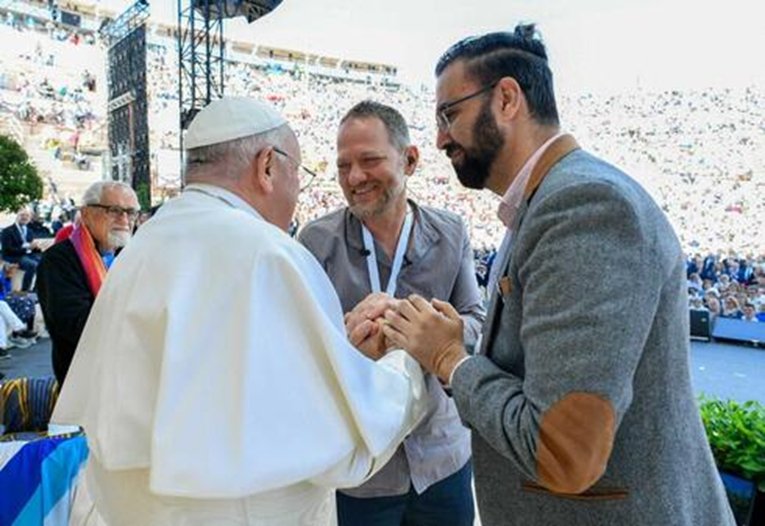
With Palestinian partners, Maoz  is using his entrepreneurial skills to address the enormous challenge of reshaping the narrative and enabling some movement towards bridgebuilding. On Saturday 18th May, along with regular conversation partner, Palestinian Aziz abu Sarah, Maoz addressed Pope Francis at a peace conference in Verona and told him, ‘We are entrepreneurs and we believe peace is the greatest enterprise to be achieved.’ https://www.instagram.com/vaticannews/reel/C7HD4AgtOgR/

In a talk launching the newest series of TED talks in April 2024 Maoz and Aziz gave a bit more detail. https://www.youtube.com/watch?v=0juLRi90kRg&t=990s Their love and respect for one another is obvious and moving, and they know that to change the polarised narrative they need to present together. I thoroughly recommend the TED talk. Towards the end, having outlined how he feels his parents prepared him to walk a path of peace, Maoz talks about how forgiveness is key: ‘we must forgive the past and the present , but forgiveness is not for the future. Instead, a new future must be made.’ Maoz calls it a ‘miracle’ and says ‘Our stories meet in the future.’

The future Maoz and Aziz dream about encompasses reconciliation and recognition of the other, security and safety and equality. It is a lofty dream and cynics might scoff, but there is something very grounded about their determination to amplify their voices and build legitimacy as leaders.

The TED talk finishes with an analysis of hope which is not something you can find or lose, says Maoz, it is something you must make. He credits his Palestinian dialogue partners for teaching him this. And they invite all who dream of a peaceful future to join in working to make that dream a reality.

I find heartening Maoz and Azif and all the others who have consistently since 7th October rejected revenge and remembered the humanity of Palestinians trapped in Gaza, along with the humanity of the hostages and the young IDF soldiers.

They ask us to amplify their voices, to refuse to be enemies. This is a huge challenge and can seem naive and unrealistic. But unless we see the humanity of all, and treat one another as sisters and brothers, we are doomed to repeated violence and horror and grief.

Shared grief; shared hope

Yesterday in Israel was Memorial Day. It is a solemn period of reflection, commemorating all Israelis who have died since 1948 whether in war or in the ongoing attrition that is ‘normal’ life here. Israelis are remembered, but Palestinians are not. Since 1948 the number of Palestinian dead has outstripped the number of Israeli dead many times, but Memorial Day and the following day, Independence Day, are one-sided affairs.

For 19 years, however, there has been a joint Memorial Day event recognizing the bereaved who are both Palestinian and Israeli. It is held by Combatants for Peace and Parents Circle Family Forum. Robi Damelin of PCFF wrote an opinion piece in English explaining her own commitment to holding the grief of all together. She sent me a copy of it yesterday.

This year’s joint Memorial Day event, the first since October 7th, was more sensitive than ever. So much grief; so much so raw.  The event itself was not public and people were invited to join a live stream. Even this was attacked by hackers who took over the Youtube channel and streamed Israeli only memorial content. This distraction was quickly overcome and we watched on Facebook. The whole event is available on the Combatants for Peace Youtube channel. https://www.youtube.com/watch?v=tnueJD9l_n4

In her article, Robi talks about a softness and compassion that enveloped the organisers as they planned the event. ‘because we are all so very sad.’ But she goes on:

‘We are also certain that now more than ever our message of non-violence, reconciliation and call to end the war must be heard.’

Through music, poetry and testimony, focusing on the children affected by the terrible events of October 7th and since in Gaza and the West Bank, space was made to share sadness and grief but also to share a commitment to peacemaking with justice. Jonathan Zeigen, whose mother was well-known and beloved peace activist Vivian Silver, talked of his reluctance to take up her torch, but also the impossibility of not doing so. ‘Now, against my will, the torch has been passed on to me,’ he said. And he asked us, ‘How many generations of bereavement must there be until we understand that the only way for all the people between the Jordan River and the sea to live in security and freedom is through peace?’

Ghadir Hana movingly read the words of a Palestinian woman, Najla, who mourns the death of her beloved brother Abd al Rahman in Gaza, and twenty other relatives. She set the context for the ongoing indignities and privations experienced by Gazans and their families elsewhere before October 7th. They had applied repeatedly for permits to travel for weddings and were always denied. On December 30th Abd al Rahman was shot in the street while out searching for diapers and milk for his two year old twins. His sister said of him, ‘He was a simple person carrying nothing but the hope for a life lived with dignity.’

As Ghadir Hana spoke Najla’s words the camera scanned the crowd, showing faces filled with compassion and comprehension of her grief. She feels that she had to join PCFF, even though some in her family don’t understand, because the shared grief is a way forward.

I have written before of how the events of October 7th smashed relationships between Palestinians and Israelis and tore apart peacemaking initiatives. In the words and the music and the dreams of the children this joint memorial event revealed pain but also hope and a determination to be part of a different future.

It may be an hour’s memorial is too much for you. I urge you then to watch this 3 minute clip advertising the 2023 event. https://www.youtube.com/watch?v=eJut0NxnwHw

And I suppose I want to finish with a question for myself, first of all, but also for everyone. These voices are still so marginal and counter cultural, and so very nearly drowned out by louder hate-filled voices. ‘How can these voices be amplified? What can we do to help them be heard?