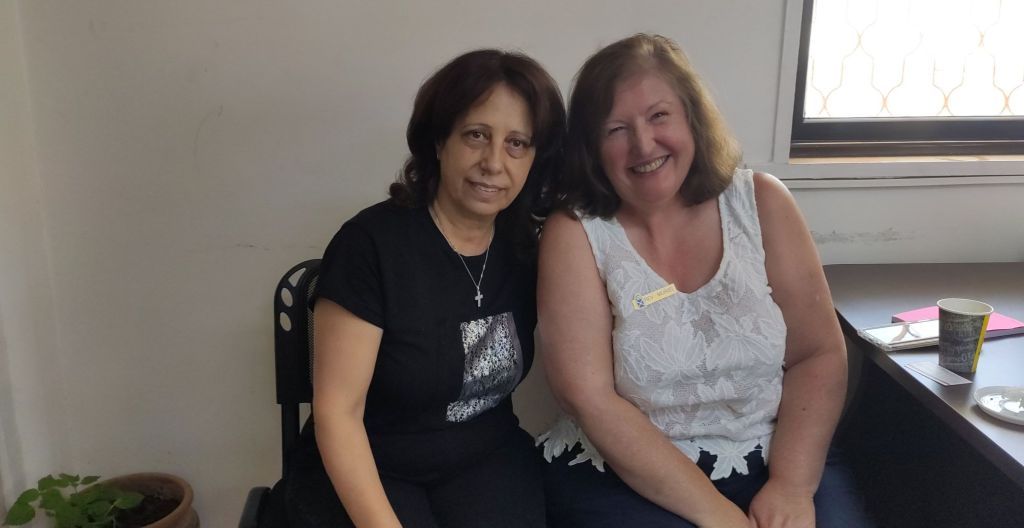
In the short time I’ve been in Israel/Palestine I’ve met some remarkable people. Many of them work in grassroots organisations that try from the ground up to improve life for people. One of these is Basma who is director of the Al-Basmah Centre, run by the Arab Women’s Union in Beit Sahour, in the greater Bethlehem area.
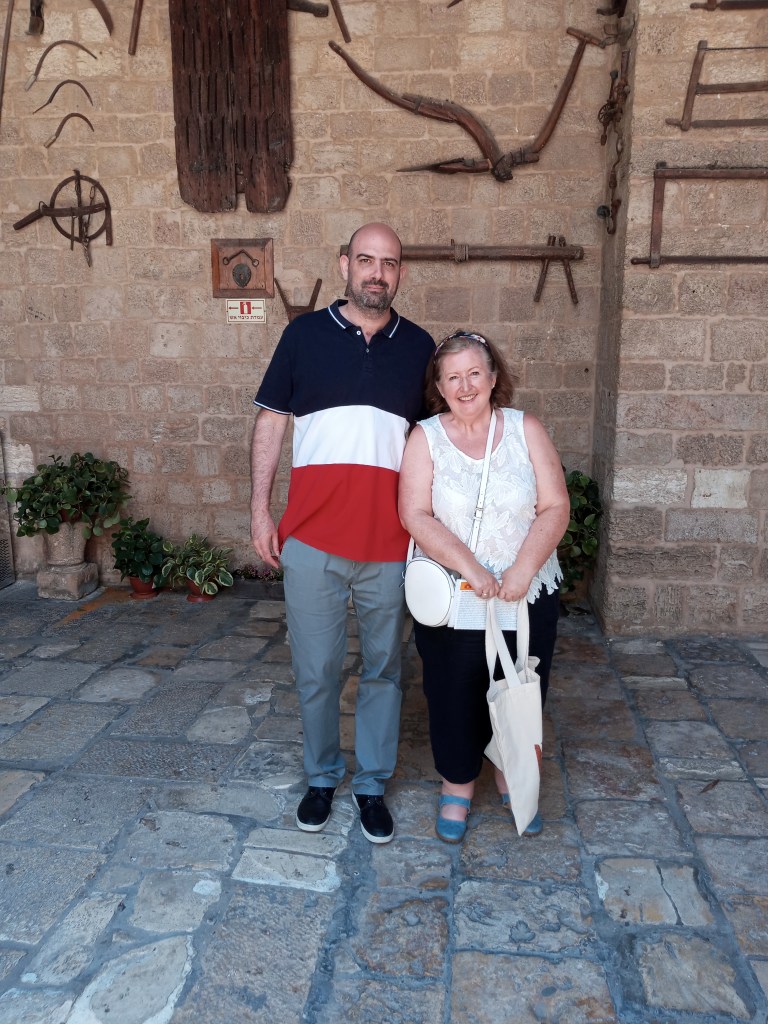
Basma and Muriel
Al-basmah started with a small group of adults with learning difficulties (who are not well served in the community) and provides social activities, some exercise and some employment, one of which is making rag rugs. I had gone with boxes of sheets no longer needed in the Scots Hotel. The work with young adults has expanded since the group started in 1987 from 5 to 32.
What interests me about Al Basmah is the way the organisation has grown organically and in response to identified needs. There is a Guest House, a kindergarten, and The Union which is a fascinating social enterprise.
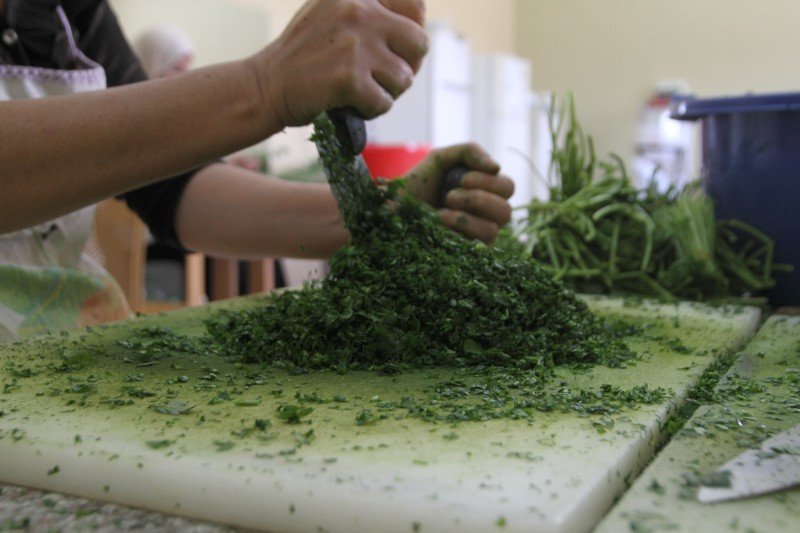
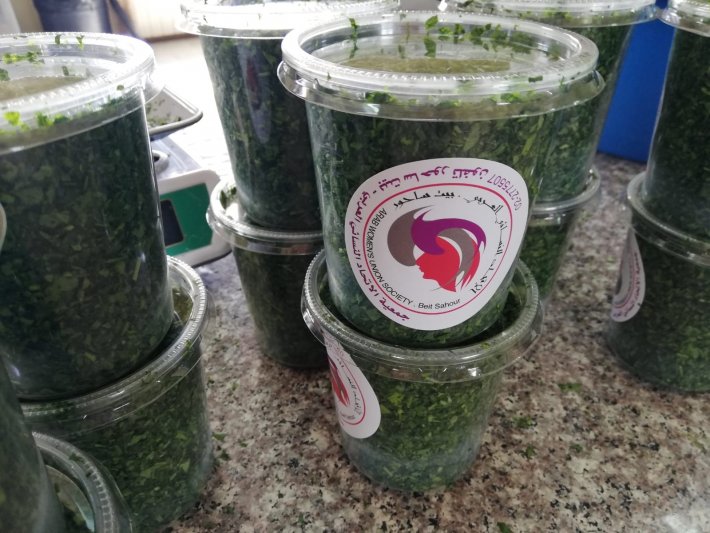
Cooking is very time consuming and labour intensive for Palestinian women. Everything is prepared from scratch including all the fresh herbs and spices. The Union was set up to save working women one or two hours when preparing meals. Basma took me up to see the large preparation space where mallow, mint and parsley is washed and prepared.
Preparing mallowReady for sale
It is difficult for women to find work. Of the 10 women employed in the food preparation several have PhDs. During my visit the front office was busy all the time with people coming in and out collecting their orders of prepared herbs and ready meals.
The Arab Women’s Union was founded in 1956 and aims to promote women’s rights : economic, social, cultural and rehabilitative. It provides day care, the kitchen, the social and cultural programs, as well as the Al-Basmah Center for people with disability.
The buzz around the front office and the ability of admin and finance staff to concentrate amidst the bustle reminded me of Cranhill Development Trust in Glasgow where I was involved for many years. Families in Bethlehem and the West Bank face occupation and the struggles it brings daily, but they also face problems similar to women the world over: access to education, employment, affordable child care, support for children living with disability.
During the corona pandemic the nursery remained open and the food prepared by the Union kitchen was more important than ever. The organisation reached out to its members and still does, as the economy has not recovered. Funding, as for many grassroots organisations is precarious, especially since the pandemic when funders also felt the pinch and donations have contracted. The resilience and resourcefulness of the women, and their ability to be entrepreneurial is to be celebrated.
Full disclosure: I’ve not yet been to Gaza, though hope to visit in the Autumn. Following last week’s aerial bombardment, I’ve been reading and thinking about the place a lot. And I want to focus on the children.
As I said in my last blog, Gaza is a tiny strip of land with a border with Egypt and the sea and the other two borders with Israel. Of the population of 2.1 million, 50% are children. The blockade of Gaza began in 2007 when Hamas gained power. Israel has officially withdrawn from Gaza, but since in reality Israel controls all access of people and goods, Gaza is under siege.
Since 2007 when Hamas ousted Fatah and Israel and Egypt blockaded the strip there have been 5 major attacks by Israel targeting militants or tunnels or rocket launch sites: and Israel defends these attacks as appropriate actions to protect Israeli citizens. But the firepower at the disposal of Palestinian militants is dwarfed by the attack and defense weapons and troops available to Israel. Palestinians prefer not to use the word ‘war’ because that suggests an equal struggle. They call them aggressions.
In between the aggressions, there is constant observation and drone activity. Passes to travel in and out of Gaza have been hard to come by, even in cases of medical emergency, though in the past year more work visas have been issued. 50% of those living in Gaza are unemployed. A majority of families are reliant on UN food aid. Basic amenities like water and electricity and medicine often run out.
This is the environment in which these children are growing up. After the last aggression in May 2021 and the pandemic, Save the Children repeated a survey first carried out in 2018. The first survey showed 60% of children felt anxious and afraid when separated from their parents. In 2022, before the latest escalation, 90% reported symptoms associated with trauma. 96% of caregivers also reported chronic stress and helplessness. https://resourcecentre.savethechildren.net/document/trapped-the-impact-of-15-years-of-blockade-on-the-mental-health-of-gazas-children/
Children aged 15 and under have never lived in any other situation, and there is not time between attacks to recover psychologically. Symptoms of PTSD are common, but the ‘post’ is a misnomer: the trauma is ongoing.
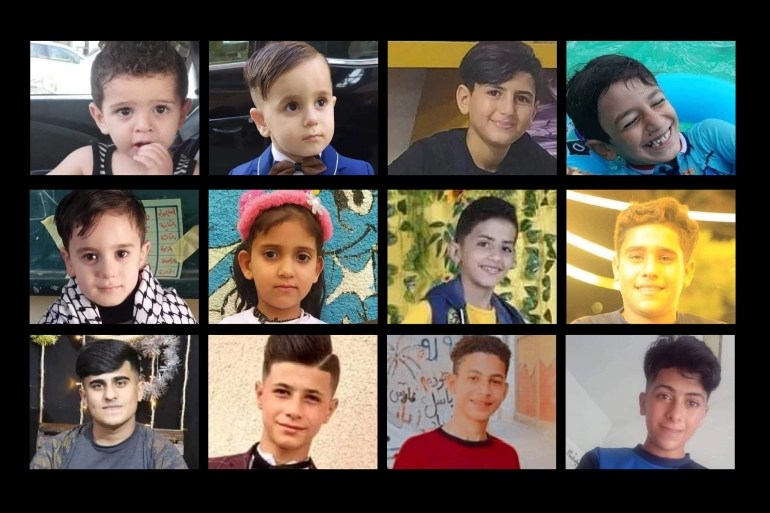
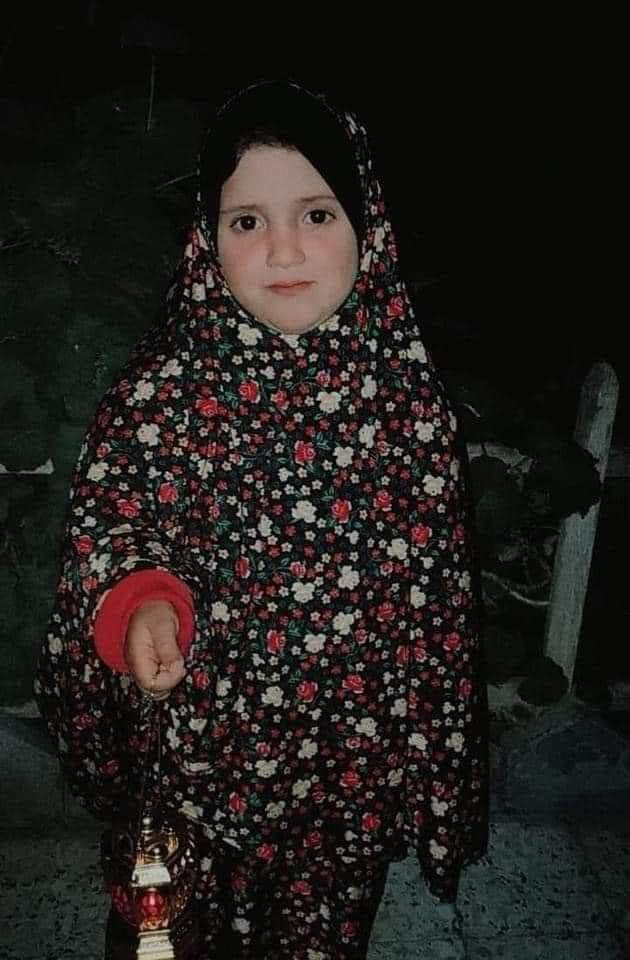
In the August 2022 escalation 46 people were killed, 16 of whom were children. There were more than 450 injuries, many of them children. I wrote about Alaa Qaddoum in my last blog, killed aged 5. One of the photographs of her released by the family shows her wearing her graduation t-shirt for kindergarten and clutching her certificate. Her grandfather said, ‘What did she do? What crime did she commit? She wanted to go to nursery, she was asking for clothes and books.’
The bright faces of 12 of the 16 victims, in a graphic by Defense for Children International, look out onto a future that is not theirs. I find it remarkable that against the odds, and with all their fears, Gazan children are still studying at school, still dreaming of careers, still taking degrees. In a Deep Dive conversation, available on Youtube entitled Gaza is a Children’s Prison: Mental health Crisis[1] 17 year old Hind Wihaidi said, ‘People are doing their best to make connections to achieve their dreams…they are trying to create opportunities out of the rubble.’ But she also pointed out that children’s basic human rights are not being met.
Israel says that some of the children died because of misfiring Islamic Jihadi rockets, though Gazans dispute that. Israel’s Iron Dome prevented most PIJ rockets reaching their targets, but Israeli children also felt fear and had to spend time in air raid shelters. Their distress is real too.
So what is the game plan? What happens next? How can all the young people of Israel, Palestine and Gaza be allowed to flourish?
Since this blog was written on Saturday 6th August, more children and women have been killed in Gaza and rockets fired from Gaza have reached the edge of west Jerusalem. More collateral damage.
Five year old Alaa Qaddoum was killed on Friday during an Israeli assassination strike against a leader of Islamic Jihad. The Gaza strip is 365 km² and has a population of between 2.1 and 2.2 million. Gaza city has an estimated population of 590,481. The Isle of Jura, off the west cost of Scotland, has similar dimensions and area, and a population of 196. It is impossible to fire rockets into Gaza without ‘collateral damage’. Alaa Qaddom and a 23 year old woman are dead, along with a number of Palestinian Islamic Jihadists (PIJ)
Alaa Qaddoum, photographer unknown
The BBC reported, ‘On Monday night, 1st August 2022, Israeli security forces arrested Bassem Saadi, reported to be the head of PIJ in the West Bank. He was held in the Jenin area as part of an ongoing series of arrest operations after a wave of attacks by Israeli Arabs and Palestinians that left 17 Israelis and two Ukrainians dead. Two of the attackers came from the Jenin district.’
Following the arrest Palestinian Islamic Jihad issued threats which Israel says were specific. This led to Friday’s airstrike which killed 10, including Alaa.
Israel says over 100 rockets have been fired from Gaza into Israel. There are no reports of any casualties. Yet.
Hamas, which governs in Gaza, while reacting angrily to the attack, has not launched any physical retaliatory action yet. The calculation is that they cannot win militarily. Also, they want to protect the jobs of Gazans who have been working in Israel and maintain the flow of goods necessary for ‘normal’ life. It is a difficult line to hold when feeling will be running high in Gaza and among many Palestinians whether in the West Bank or Israel. Memories of the violence across Israel last May 2021 are still raw.
There is some cynical speculation that caretaker prime minister Yair Lapid is bolstering his reputation in a time of election. Traditionally when Israelis have felt threatened support for the government ruling party has increased.
World reaction has been predictable, and has fallen along familiar lines. The UN condemns and calls for restraint. The US says it supports Israel’s right to self defence. John Kirby, US National Security Council coordinator for strategic communications, defended Israel’s attack on Gaza and urged both sides to de-escalate the situation. “We remain unwavering in our commitment to Israel’s security, and we will continue to work to strengthen all aspects of the US-Israeli partnership,” he said.
Meanwhile in Tiberias I went for a swim in the Sea of Galilee this morning. I put on a washing which will be dry by lunchtime. I’m preparing for worship in St Andrew’s Tiberias tomorrow where we will baptise a little boy.
When the war of words and the rocket attacks subside, as they will, what will have been achieved? It is an impossible situation. Tension and violence have been increasing. Increased Settler violence against Palestinians in the West Bank is a worrying trend. Live ammunition used against stone throwing youths means the death toll mounts; along with the grief, the trauma, the anger and for some, the urge for revenge. In 2022 there has been an increase in attacks by individual Palestinians against Israelis. But the disproportionate death toll (documented by human rights organisation B’tselem https://statistics.btselem.org/en/all-fatalities/by-date-of-incident?section=overall&tab=overview ) shows where and how most deaths occur.
It all seems so pointless, so intractable, so inevitable. While occupation and injustice persist, while Israelis believe Palestinians want them gone, attacks like Friday’s will continue.
Alaa Qaddoum is dead. Her family mourn a bright, beautiful girl. Every human being, made in the image of God, should be allowed to flourish. So many, here and all around the world are not given that opportunity. The Christian community in the Holy Land advocates non-violent means in pursuit of justice, along with many Muslims and Jews who also yearn for peace. But peace without justice is at best temporary. In memory of Alaa Qaddoum and Shireen Abu Akleh and countless others, Lord, help me pray for and work for true peace.
Hospitality and House of Grace are synonymous. Not only are there coffee and water and sweet treats as a visitor, but hospitality is at the heart of the vision of the House of Grace itself, opened to receive former prisoners transitioning to life ‘on the outside’ by Kamil and Agnes Shehade in 1982.
Growing up, Jamal and Thomas did not realise there was anything different about their home, until they discovered school friends were forbidden to visit because of fear of what ‘former inmates’ might do. Over time, this attitude softened a little and even some of their friends’ parents came around. The welcome is so warm, the atmosphere so welcoming, it is easy to understand why.
Kamil and Agnes had a vision for the abandoned shell of The Church of our Lady in downtown Haifa. They rebuilt it, and opened it as a half-way house for men leaving prison as some of the most marginalized people in Israeli society.
Over time, the city of Haifa have allowed government buildings and banks to grow up around the little church, as if to hide it. But it is still here, and people still seek it out and find refuge here.
11% of the population of Haifa is Arab (some prefer Palestinian), and 20% across Israel, but they make up 40% of the prison population in Israel. Some of these men have been imprisoned for a long time for minor crimes, most have faced enormous struggles in life, including a lack of stability in family life, poor education and lack of opportunity. It is difficult to find well paid work, build a home, raise a family; in short, to flourish.
Recent laws in Israel such as the 2018 Nationality Act, which define what it means to be an Israeli and demotes Arabic to a second language no longer required on legal documents, make things even more difficult for men who may be illiterate and certainly would not have been taught Hebrew to any high standard.
And some have been so long in a harsh prison environment that kindness and good relationships with partners and children are harder to sustain.
Through its programmes, House of Grace helps men find some inner peace, some self-esteem, learn some skills and build better relationships.
Over time, obvious needs for family support in the community and young people who have far less spent on them in terms of education and after school activities led to new programmes. The infrastructure of this became really important in the pandemic.
This is what grassroots activism is. Small acts of grace on limited budgets, bearing fruit over time in unforeseen ways. And still faithful to Kamil and Agnes’s Matthew 25 faith.
I was struck by the similarities in response from House of Grace with Cranhill Development Trust, based In Cranhill in the east end of Glasgow, where I was minister for 17 years. Food parcels, internet access, IT to allow kids to access lessons, just keeping the human connection going. And after the pandemic, the social isolation still being experienced where young people have lost two, almost three, of their most formative years.
This is what grassroots activism is. Small acts of grace on limited budgets, bearing fruit over time in unforeseen ways. And still faithful to Kamil and Agnes’s Matthew 25 faith.
Jamal Shehade at House of Grace
Haifa is only about an hour from Tiberias. I need to hang out there more, for myself. I need that kind of open handed welcome.
This blog is an adaptation of a sermon preached May 1st 2022 in St Andrew’s Galilee.
Hearing the gospel story of the disciples encountering Jesus while fishing in Galilee on a morning in May in Galilee gives a fresh complexion to it! As part of my preparation for today I decided on Thursday to go and see the ‘Jesus boat’ in the Yigal Allon Centre at the Kibbutz Ginosar. This extraordinary, lovingly preserved 1st century fishing boat was found in 1986 when the water levels in the lake were low. Having been carbon dated, it was preserved over a ten year period before going on display in 2000. Of course, no-one knows if it was a boat used by Jesus and the disciples, or an ordinary fishing boat, or whether it was used in the rebellion against the Romans when fishing boats were repurposed as war ships.
‘The Jesus Boat, The Yigal Allon Centre, Kibbutz Ginnosar
But it is instructive, for lots of reasons. Firstly, it is quite small and shallow, so when the wind whips up the waves on the Sea of Galilee you can imagine how easily the small boat would be overwhelmed. You can also imagine what close quarters the crew would be in and how they’d have to work together. There would be no need for team building exercises with this team: they’d have to listen to each other, respond to body language and move to balance the craft if a heavy netful of fish were dragged in.
Also interesting to me is that the boat itself is made up of twelve different sorts of wood and had been patched many times. It suggests that fishing was a tough life. Economic conditions were a catalyst for the rebellion against the Romans led by Judas the Galilean in 6CE (while Jesus was a very small boy), and so brutally put down such that Josephus recorded that the sea ran red with blood.
Again, there is no evidence that the Jesus boat was ever caught up in rebellion, but it is a reminder of the woeful economic conditions most people struggled with all the time, and the context for Jesus’ bread multiplying ministry.
The shores of the Sea of Galilee, or Lake Tiberias, had been home to Jesus and his followers, and John has the disciples (or some of them) back there in the days following Jesus’ crucifixion and early rumours of his resurrection.
The story begins in the dark again. The disciples had fished all night and caught nothing. We can imagine them, chilled to the bone, waiting gloomily for dawn and finding failure in this familiar fishing as well as in the new fishing Jesus had promised them, cut short by a conspiracy between the priests and the politicians in Jerusalem.
But then, just as light steals across the Galilean hills and the dawn chorus tunes up, something happens. Jesus appears to them. He comes to them. He stands on the shore and he calls out to them, “Any fish?”
‘Nothing,” they replied.
And then the key turning point. This stranger on the shore said, “Let down your net on the other side.” And they did. And the net came up so full it seemed at breaking point. And then the disciple Jesus loved made his confession of faith: “It is the Lord!”
But it was Peter who threw on his clothes and swam or waded ashore. Why did he dress for swimming? Because he knew he was going onto holy ground.
John tells us there was a charcoal fire burning, the coals nicely glowing and ready for cooking, and some fish already on it. The scent of barbequed fish must have been glorious to these hungry fishermen.
Jesus speaks again to tell them to bring some fish, and again, Simon Peter obeys. He goes back to the boat and drags in the huge catch. Why 153 fish? Does it just mean a lot? Or is there some symbolic meaning to the number;lost in time? It has been speculated that the catch represents every nation known on earth at that time. It is perhaps enough to think about the net going from empty to full because they had listened to Jesus.
And Jesus invites them to come and eat. Repeating actions they had seen many times all across the countryside, and in an upper room in Jerusalem, Jesus took bread and broke it and shared it and did the same with the fish. The story echoes the feeding of the crowd where fish and bread miraculously fed 5000 men and women and children besides.
In this story physical and spiritual crash together. It’s a mystery. How can this man they knew to be dead be on the shore sharing fish and bread? But the hunger was real and the need was real and the faith was real. ‘They knew he was the Lord.’And we can go further. Now there is no longer ordinary and sacred: everything is transformed in the light of the resurrection. This insight into the sacredness of the whole creation, or the hallowedness of the ordinary is something Celtic Christianity, fostered by St Columba of Iona emphasized, and revived by the modern Iona Community. In the light of the resurrection every blessed thing is holy. And the sacrament of communion seen in in our story of shared fish and bread and to be celebrated here in a few minutes points us to this. Rachel Held Evans put it like this:This is the purpose of the sacraments, of the church—to help us see, to point to the bread and wine, the orchids and the food pantries, the post-funeral potlucks and the post-communion dance parties, and say: pay attention, this stuff matters; these things are holy.
The second part of the reading, as I said earlier, is about Peter’s rehabilitation. He has shown his trustworthiness in listening to Jesus and obeying him. Now he is entrusted with the task of leadership. In words which echo Jesus’ calling himself the good shepherd, Peter is tasked with caring for and feeding the sheep. He is hurt that Jesus asks him three times whether he loves him, but each declaration of love cancels out a betrayal in the high priest’s courtyard.
The last thing Jesus says to Peter repeats what the gospels say happened right at the beginning: Jesus said to Peter, ‘Follow me!’
Jesus has predicted Peter’s arrest and his death which we believe took place in Rome. On the walls of a catacomb in Rome is scratched the image of a small boat. The fishing boat had become a symbol of the church. You might say that’s not surprising as so many of the first disciples were fisherfolk, but I think it is more than that.
A grafitti symbolising the church
The small ship of faith, out on the wide sea and tossed about by currents and winds beyond its control is a good picture of the church. The crew, you and me as members,pulling together on sheets and bailing as needed, each one a part to play.
But most importantly, as this story shows, listening for the voice of Jesus, obeying him, following him. Caring and feeding and multiplying, and in so doing finding new life and new hope. A resurrection for Peter and for us.
A week past Friday I was in Jerusalem for the first time for several years. The old city was quiet. I went with Bart McKettrick and Gordon McKenzie who are members of the board of the Church of Scotland’s Tabeetha School, along with me. Gordon had never been to Jerusalem before and Bart was giving us a quick tour before a day of reflection and writing as governors.
Bart took us to the Church of the Holy Sepulchre. There was a service going on upstairs and the deep, sonorous melodies of the chants filled the space. But there were very few tourists and pilgrims.
Bart took us to the site of the tomb.
As you probably know, often there are long queues of pilgrims waiting patiently to dip their heads and peek in. On this day we were able to step inside, the three of us, and spend quite a long time. The floor is worn by the steps of shuffling pilgrims, the marble bench polished smooth by prayerful hands. Unlike other sites of veneration, the additional art and gilt and ikons are restrained. This is an empty tomb. There is nothing there.
And that is the point.
Each gospel tells a slightly different version of the same story: a woman, or some women, while it was still dark, as soon as they could after Sabbath had ended, went to the tomb expecting to anoint the body of their beloved friend, and they found it empty. The stone rolled away, the body gone. In some versions there are two men in white who tell the women , ‘Don’t be afraid…go…tell…’
And they do. Their impossible tale is met with a spectrum of disbelief and incredulity, but over time, the disciples, too, are met by the Risen Jesus. The marks of his suffering are still visible, but he breathes on them life.
The small frightened band gain confidence and find their voices and their mission. They do not melt away back to Galilee. They do not hide away for fear they will suffer the same fate as their leader. They continue to meet. They continue to pray together. They continue to share meals.
The Resurrection is an unfolding story. Christ is alive. And because Christ is alive the world can change.
Although we often fail our Lord, as Rowan Williams puts it, ‘The body of Christ shows that there are ways of living together as human beings that are not tribal, violent, exclusive and anxious.’
Our service today in St Andrew’s Galilee will end with Desmond Tutu’s affirmation of faith:
Leader
Goodness is stronger than evil
ALL
LOVE IS STRONGER THAN HATE
Leader
Light is stronger than darkness
ALL
LIFE IS STRONGER THAN DEATH
Leader
Victory is ours through Him who loved us.
Living Lord,
Breathe your life into us now
So that, transformed,
We may live out of hope and not fear
Sharing your story as Resurrection people
Whose song is Alleluia!
Amen.
The Empty Tomb, Church of the Holy Sepulchre, Jerusalem
Are you tempted to rush forward from Good Friday to Easter Sunday? To get all that talk of death out of the way? The Christian calendar seems to facilitate this. Not many traditions linger on what has been described as the long hiatus of Holy Saturday. And yet, to make sense of faith and life in our world now we need to be able to talk about death, not only physical death but also ecological catastrophe, and the death of optimism and certainty.
Alan Lewis wrote about this in his book, Between Cross and Resurrection (Eerdmans, 2001). This is one of the books still sitting snugly in my Gorbal’s study, but I found an extended quote on the Methodist hymnary website:
‘…if we believe that God lived in and through Jesus Christ then it’s important for us to think not only about what was happening to Jesus, dead and buried, but what was happening to God . . . also dead and buried. It’s a tough idea to get your head round – that God, too, experiences death on the cross and “knows how to die”.
Alan came to understand that God’s aloneness and despair on Holy Saturday is precisely that part of the Easter story that most closely mirrors so much of our own human experience. Three events of the last century, he suggests, bring into focus the sense of despair we so often feel about our world:
Auschwitz Hiroshima Chernobyl. . .
. . . three events that represent the possibility of soulless inhumanity, a nuclear winter and, at Chernobyl, “the terrible possibility of planetary death . . . the ultimate eco-catastrophe”.
Alan asks: “Who and where is God if God’s power and love can sustain such losses and accede to such defeats?” Is God uninterested, absent or dead?’
The 21st century, sadly, has examples of its own of inhumanity and ecological disaster
War in Syria, Yemen and Ukraine; crisis in Afghanistan; global hunger; the proposed UK deal with Rwanda to relocate asylum seekers; plastic in oceans and global warming. And here in Israel and the occupied Palestinian territories the consequences of a failure to find ways to honour the human rights of all citizens of this small, contested country.
For Alan, Holy Saturday points to a new way of being. On Holy Saturday, the cold presence of the tomb (Jesus and all he stood for trapped behind an immoveable rock) speaks of collapsed confidence and abolished optimism. This was the experience of the disciples – wherever it was they’d fled to.
But the bleakness of their situation and the cruel insinuations of the tomb open us, as it would eventually open them, to the possibility of a different way of looking at tomorrow: a way not of fragile, shattered optimism but of strong un-killable hope.
“For hope, finding space to flourish in the very absence of optimism, is the courage not to be swallowed by despair but, in frank acknowledgement of rampant evil and negation, to trust in the possibility for life and creativity amid and beyond that malign [super-power], though assuredly not in its denial or avoidance. The very realities which banish confidence and legitimise despair also invite a hopeful embrace of love’s living power to prevail in history.”[1]
At 6 am Lion’s Gate, Jerusalem, 15th April 2022. Families, many with young children were leaving the Al Aqsa Mosque. The atmosphere was calm. Children carried their balloons and bubble machines. At 6.30am the atmosphere changed. Everyone had a mobile phone in hand, so they knew at once there had been some kind of trouble. Some moved towards it and some moved quickly away. There were Police and soldiers watching every move.
Groups of young men, haircuts sharp and trouser legs narrow, gathered restlessly, full of nervous energy.
I was moving alone up the street, dog collar on and backpack carrying the words needed to walk the Stations of the Cross on the Via Dolorosa. I caught up with a tiny nun moving the same way, against the flow of the crowd leaving the mosque. We said hello.
As we passed a small cluster of soldiers, fingers on trigger, I said, ‘This must have been what it was like in Jerusalem in Jesus’ day.’ ‘I’ve often thought that,’ she replied.
Up until now, there has been restraint shown. Keeping the peace is not easy.
Always a contested space, this year because Ramadan and Pesach and Holy Week coincide, there is more pressure. Our pilgrim band walked the way of the cross, read the familiar words of the gospels, prayed powerful prayers, but did not linger. By 10 am we were in a coffee shop.
In penitence and sorrow for each time right is obscured by might;
For every time the powerful are given undue respect while the weak and powerless, the poor and the dispossessed are ignored and repressed;
We pray for liberation of women and for liberation of men.
Leadership style is very much in the news. President Zalensky’s brave, down to earth, chair carrying, among-the-people style contrasts with President Putin’s long table and paranoid detachment. And UK government leaders’ sense of entitlement and privileged rule breaking leaves the rest of us reeling, angry and hurt. Those, especially, who followed the rules during lockdown and were separated from loved ones cannot treat Downing Street rule breaking as insignificant. The moniker ‘Partygate’ attempts to trivialize something utterly serious which gets at the heart of how power and privilege are used and abused.
On the Thursday of Holy Week we honour ‘servant leadership’: not a 20th century invention of management gurus but the way of life and death of a 1st century leader who overturned the hierarchy, thus bringing to the centre of attention those on whom society depended and ignored simultaneously.
John’s gospel emphasizes Jesus’ heavenly pedigree, and the choices he makes in exercising his leadership: ‘Jesus knew that the Father had given him complete power; he knew that he had come from God and was going to God. So he rose from the table, took off his outer garment and tied a towel round his waist.’ John 13:3-4
Tom Colvin’s hymn puts it starkly:
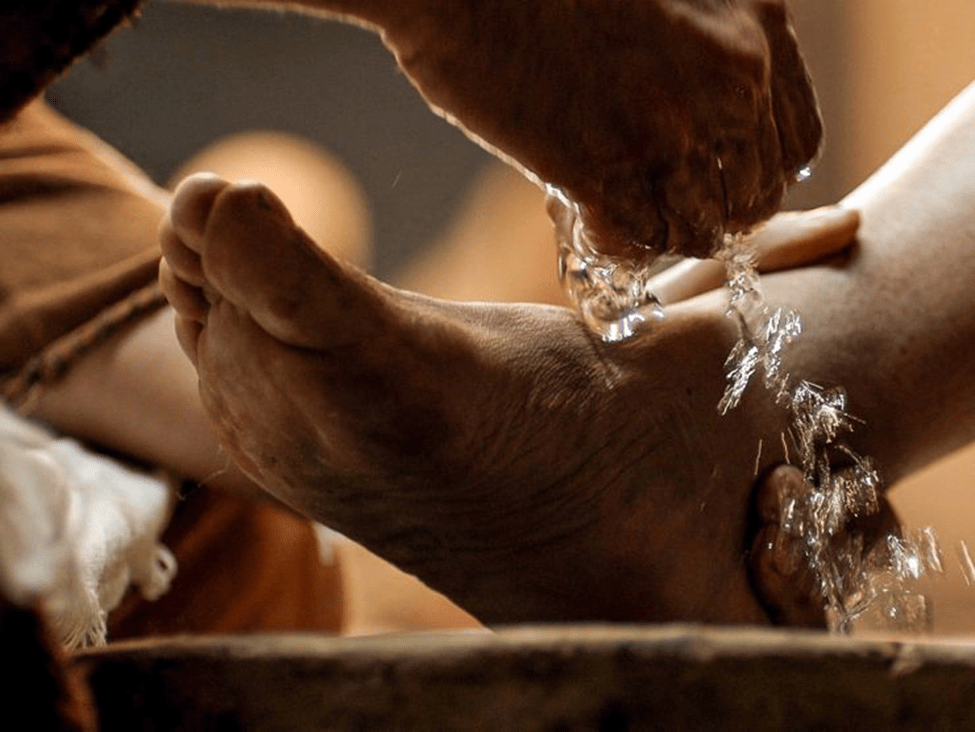
Kneels at the feet of his friends, silently washes their feet, Master who acts as a slave to them.
Jesu, Jesu, Fill us with Your love, show us how to serve The neighbours we have from You.
Washing feet is not a symbolic, religious action but a visceral act of intimate care. Jesus makes visible all the invisible ones whose back-breaking service enables society to function. He makes every human being visible and valuable. He liberates captives then and now. He models leadership for his followers.
Loving puts us on our knees, serving as though we are slaves: this is the way we should live with you.
Jesu, Jesu, Fill us with Your love, show us how to serve The neighbours we have from You.
What does it mean to betray someone or something? Judas is often portrayed as betrayer, as almost a pantomime villain. But is this fair?
We only have what the gospel writers tell us about Judas, of course, and they paint him in a pretty unsympathetic light. There is a hint of scapegoating or ‘othering’ about the way we are encouraged to see Judas as unlike us.
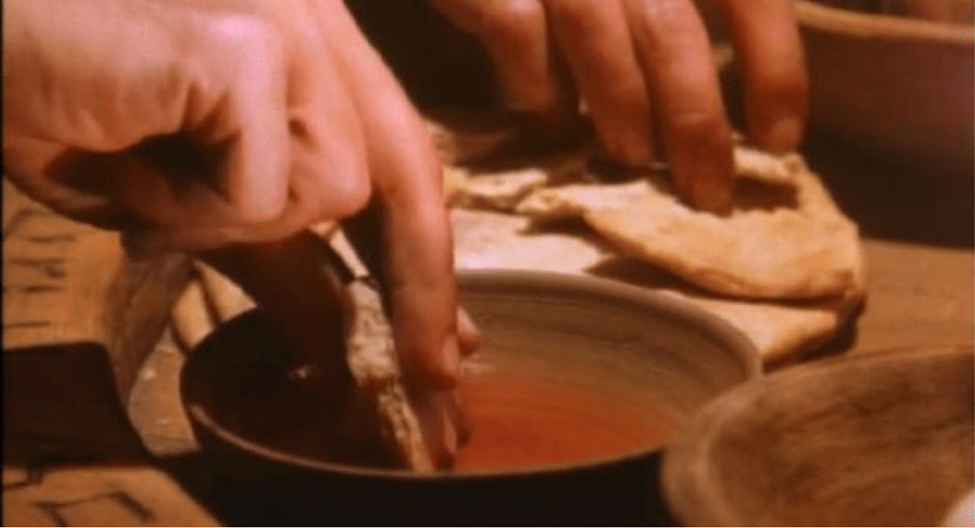
But are we so very different? And are the uncomprehending disciples, dipping bread in the sauce along with Judas and Jesus without understanding the significance of this last supper, are they any more faithful as friends?
Judas’ betrayal of Jesus may have been prompted by greed, as some gospels assert, or by a nobler ambition to have Jesus show his true power by pushing him to force his hand. We don’t know. John’s gospel says, ‘Satan entered him.’ Jesus had been tempted by Satan – the Enemy- but had not given in. Judas allowed him in.
Judas will betray Jesus with a kiss. The sign of friendship will become the act of an enemy.
All of this is part of a larger theological narrative where Jesus’ Passion is the means of reconciliation between God and humanity. Like the complexity of Judas’ relationship with Jesus, however, the atonement is not a simple substitution.
What matters to me is that Jesus never stopped loving Judas. Perhaps Judas’ true betrayal was that he pushed that love away and would not be embraced by it. He could not allow himself to be vulnerable. Perhaps he could not love himself.
George Herbert’s poem Love comes to mind:
LOVE bade me welcome; yet my soul drew back, Guilty of dust and sin. But quick-eyed Love, observing me grow slack From my first entrance in, Drew nearer to me, sweetly questioning If I lack’d anything.
‘A guest,’ I answer’d, ‘worthy to be here:’ Love said, ‘You shall be he.’ ‘I, the unkind, ungrateful? Ah, my dear, I cannot look on Thee.’ Love took my hand and smiling did reply, ‘Who made the eyes but I?’
‘Truth, Lord; but I have marr’d them: let my shame Go where it doth deserve.’ ‘And know you not,’ says Love, ‘Who bore the blame?’ ‘My dear, then I will serve.’ ‘You must sit down,’ says Love, ‘and taste my meat.’ So I did sit and eat.
Self-giving God
Whose loving never ends
Open our eyes to see ourselves and our world as you do
So that we may share your friendship
And return love for love.
Amen.
Jesus dipped the bread in the sauce and gave it to Judas. John 13: 26




 Stepping out of the boat...