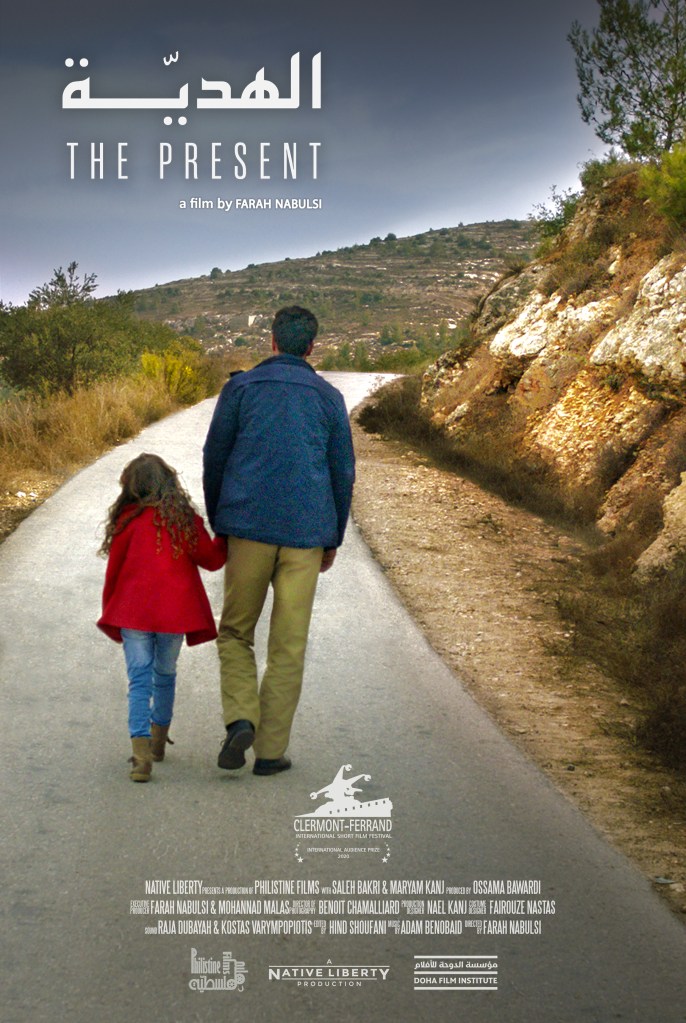
Yesterday I watched a short Palestinian film The Present by Farah Nabulsi which was released to critical acclaim in 2020. The screening was organised by the Balfour Project https://balfourproject.org/ and included a Q & A with writer and director Farah Nabulsi. It tells the story of a father and daughter who go out to buy an anniversary gift for his wife. Only, in the Occupied Palestinian Territories where checkpoints are a daily point of humiliation, this simple action is far from simple. It is not a spoiler I don’t think to let you know the gift is a new fridge which has to be transported home via a checkpoint.
On the way home the pair are delayed at the same checkpoint.
What does this present mean for the future? Is there hope for a resolution for a situation that hurts everyone but punishes Palestinians simply for existing?
Nabulsi said in the Q &A that some Palestinians had been critical that the IDF soldiers were portrayed too sympathetically and the father and daughter’s experience was too gentle. But what happens is graphic enough to highlight a number of profound themes. What does it do to a small girl to be made to wait and watch in the heat while her father is temporarily detained, stripped of his watch and his belt and his dignity? How is normal family life, symbolised by the fridge, possible against such daily degradation? What does participation as a conscripted IDF soldier do to mental health and attitudes? The three bored soldiers are not identical. One had previously made some sort of connection with the Palestinian, but will he be able to resist peer pressure? And how does the Palestinian keep his temper and retain his dignity?
The film’s title deliberately plays on the word present. What does this present mean for the future? Is there hope for a resolution for a situation that hurts everyone but punishes Palestinians simply for existing?
The film is available on Netflix. It is only half an hour long but it is well worth watching.
 Stepping out of the boat...