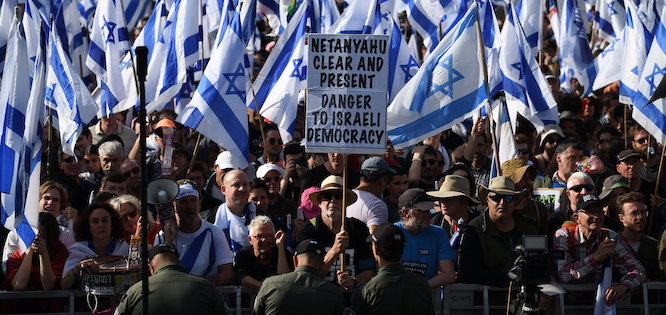
Thousands of protesters rally in Jerusalem on March 27, 2023 against the government’s plan for judicial overhaul. (Gili Yaari/NurPhoto via Getty Images)
For the past 14 weeks in Israel there have been growing protests against proposed changes to the legal system, particularly to the Supreme Court, which will weaken the power of the judiciary and put more power into the hands of whoever is in government. The new coalition of right wing settlers and religious Zionists has already started legislating. Last Thursday it is estimated 500,000 Israelis were on the streets. This Thursday there were even more. It is the biggest civil protest in Israeli history. But a very significant group is largely missing from the protests, despite being the group most affected by inequality and injustice. 20% of the population of 48 Israel is Palestinian or Arab Israeli. Why are they not on the streets?
There are several answers. One is that they have not been invited. The vast majority of those protesting for civil rights simply don’t see how their Palestinian neighbours have been systematically denied their rights. And they don’t make the connection between the changes in the judiciary and the push to take occupation further. Netanyahu has tweeted that “the Jewish people have an exclusive and unquestionable right to all areas of the Land of Israel”; sole rights, in other words, to the land between the Mediterranean and the Jordan. And extremist settlers are emboldened, as the horrific recent violence at Huwara and neighbouring West Bank villages shows. Arab Israelis are fearful that if they do join the protests, the fractured groups which make up the Israeli community will unite against them.
One Palestinian Israeli friend of mine is advising his friends to stay back and watch the drama play out between European Ashkenazi Jews who have shaped much of public life including the courts since Israel was founded and Mishrazi Jews of North African and Middle Eastern origin, who now make up 60% of the Jewish population. Mishrazi Jews would be more in favour of the changes to the powers of the judiciary and the legislature than Ashkenazi. And of course, there are many secular Israelis who oppose the formation of a solely Jewish state.
Since Netanyahu brought right wing and extreme settler parties into coalition, violence against Palestinians by some settlers while Police and military stand by and do nothing has been increasing. The worst recent example was the fire razing and destruction caused in Huwara and surrounding villages after a Palestinian killed an Israeli.
Most of those on the streets see their human rights as something separate from the Occupation or ‘the Palestinian question’, but the government needs to weaken the courts so settlement building and expansion can continue with impunity. The ‘reforms’ are not only about Netanyahu’s ‘get out of jail free’ card.
Why do well meaning, justice defending Israelis apparently not see the biggest set of injustices in the land? Jonathan Kuttab, a Palestinian Christian human rights lawyer, in his new book Beyond the Two State Solution https://jonathankuttab.org/2020/11/23/beyond-the-two-states-by-jonathan-kuttab/ pinpoints the reason as fear. Understandable fear, given the history of the Jewish people, that their land is their only home and loosening a grip on that will make them vulnerable to displacement and even annihilation.
But if fear stops you seeing the 7 million Palestinians with whom you share the land as human beings equal in the eyes of God and under the law, then you have a big problem. And Palestinians who don’t understand that the land will have to be shared for peace to take root also have a problem.
There are so few places where Jews and Palestinians can have this conversation. It is easy to get dispirited and pessimistic. There is a change going on, however. The US government is being more critical of Netanyahu than ever before and while Rishi Sunak is making deals with Netanyahu, the UK ambassador to the UN is sharply critical of Finance Minister Smotrich’s inflammatory remarks negating the existence of a people known as Palestinians.
I have one Jewish friend who sees this as a moment to be grasped to push for genuine change and genuine democracy and civil rights. I have another Palestinian friend who says, ‘It’ll settle down, you’ll see. These upsets are always coming along.’ They can’t both be right.
 Stepping out of the boat...
Hi Muriel
just wishing you well -read with interest
LikeLike